

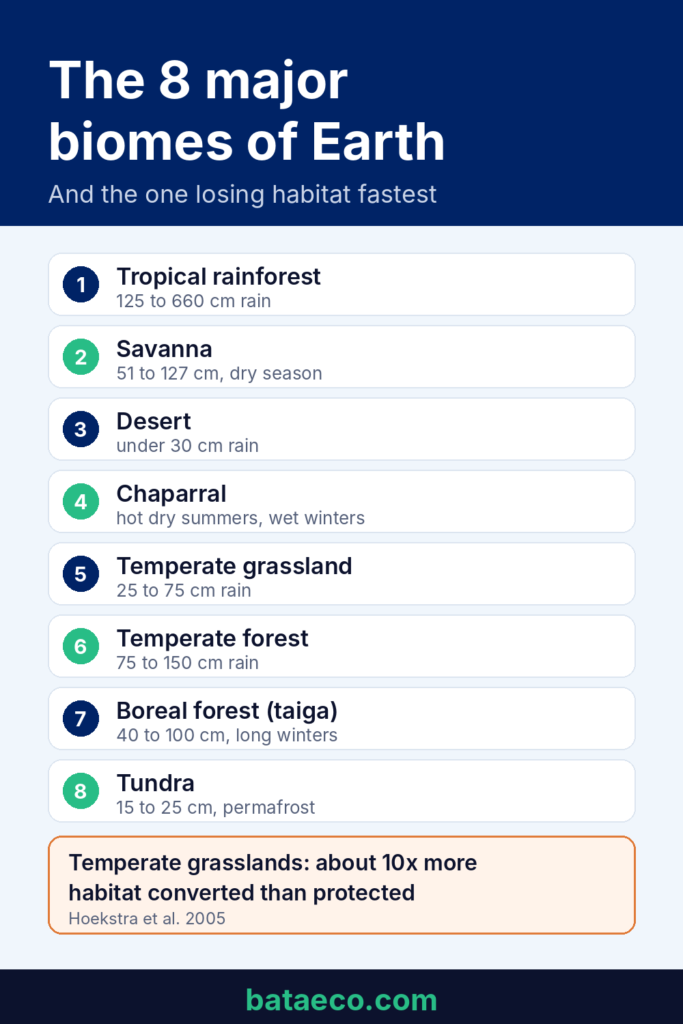
A biome is a large region of Earth defined by its climate and the kind of vegetation that climate allows. Biologists usually recognize eight major terrestrial biomes: tropical rainforest, savanna, desert, chaparral, temperate grassland, temperate forest, boreal forest (taiga) and tundra. Water adds two more broad groups, freshwater and marine. This guide walks through each type of biome, the numbers that separate them, and a data case study showing which biomes are disappearing fastest.
The short version: temperature and rainfall decide almost everything. Change how much rain falls in a year, or how cold the winter gets, and you move from forest to grassland to desert. Plants respond first, and animals follow the plants.
What Is a Biome?
A biome is a group of ecosystems that share a similar climate, similar dominant plants and similar adaptations in the animals living there. A savanna in Kenya and a savanna in northern Australia hold completely different species, yet both are grasslands with scattered trees, a long dry season and grazing animals. That shared structure is what makes them the same biome.
Biome and ecosystem are not the same thing. An ecosystem is any community of organisms interacting with its physical environment, and it can be as small as a pond. A biome is a much larger category that contains many ecosystems. Biomes are shaped by abiotic factors such as temperature, precipitation, sunlight and soil, which set the limits for what can live in a place.
The 8 Major Terrestrial Biomes at a Glance
The table below compares the major types of biomes on land. Precipitation figures are yearly totals.
| Biome | Temperature | Yearly precipitation | Dominant plants |
|---|---|---|---|
| Tropical rainforest | 20 to 34 °C all year | 125 to 660 cm | Tall broadleaf evergreen trees, vines, epiphytes |
| Savanna | Warm all year, about 24 to 29 °C | 51 to 127 cm, in 6 to 8 months | Grasses with scattered trees |
| Desert | Very hot days, cold nights (hot deserts) | Under 30 cm | Succulents, small shrubs |
| Chaparral | Hot dry summers, mild wet winters | 65 to 75 cm | Evergreen shrubs adapted to fire |
| Temperate grassland | Hot summers, cold winters | 25 to 75 cm | Grasses, few trees |
| Temperate forest | -30 to 30 °C | 75 to 150 cm | Deciduous broadleaf trees |
| Boreal forest (taiga) | Long cold winters, short summers | 40 to 100 cm | Conifers such as spruce, fir, pine |
| Tundra | Winter average -34 °C, summer 3 to 12 °C | 15 to 25 cm | Mosses, lichens, sedges, dwarf shrubs |
Sources: OpenStax Biology 2e and the UC Museum of Paleontology. Ranges vary between textbooks because biome borders are gradual, not sharp lines.
Tropical Rainforest
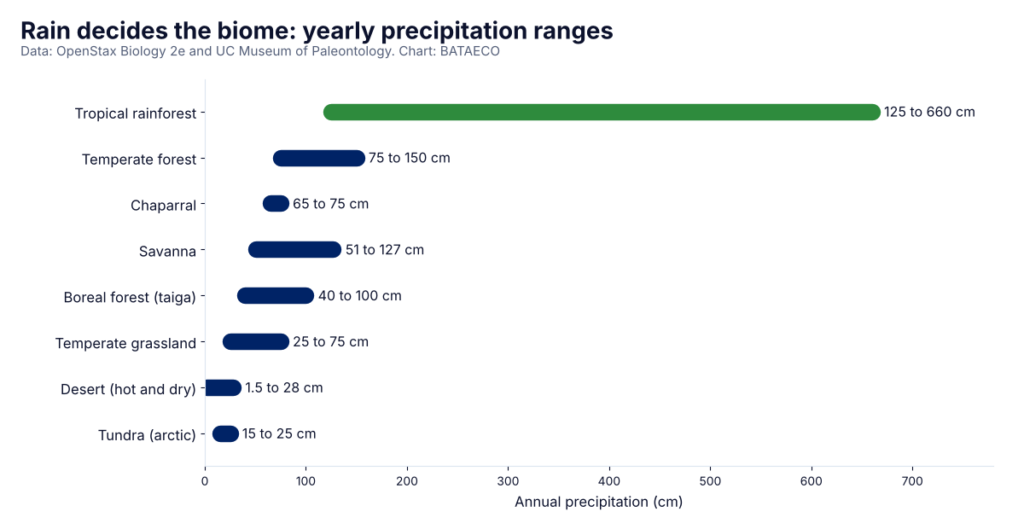
Tropical rainforests sit near the equator, roughly between 23.5° N and 23.5° S, where day length stays close to 12 hours all year. Temperatures range from about 20 to 34 °C, and yearly rainfall runs from 125 cm to more than 600 cm. With warmth and water never in short supply, plants grow year round and compete mostly for light.
That competition builds layers: emergent trees above a closed canopy, an understory of shade tolerant plants, and a dark forest floor. Many plants grow on other plants (epiphytes such as orchids and bromeliads) to reach the light. Soils are often poor because nutrients are taken up by living plants almost as fast as dead material decomposes. Tropical rainforests hold the highest species diversity of any land biome, which is why their loss matters so much.
Savanna
A savanna is a tropical grassland with scattered trees. It is warm all year, and the defining feature is seasonal rain: about 51 to 127 cm falls in a year, concentrated in six to eight months, followed by a long drought. Fire is common in the dry season and helps keep trees from closing into forest.
Savanna plants survive drought and fire with deep roots, thick bark and underground storage organs. Grasses regrow quickly from the base after grazing or burning. The biome supports the large herds of grazing mammals people picture in East Africa, but savannas also cover large parts of South America, India and northern Australia.
Desert
Deserts are defined by drought, not heat. Most receive less than 30 cm of precipitation a year, and the driest places, such as the Atacama in Chile and the inner Sahara, can receive under 1.5 cm. Hot deserts can heat the soil surface above 60 °C in the day, then drop close to freezing at night because dry air and clear skies let heat escape. Cold deserts, such as the Gobi, have freezing winters.
Desert plants save water in clever ways: succulent stems, reduced or absent leaves, waxy coatings and CAM photosynthesis, which opens stomata at night when it is cooler. Many annual plants survive as seeds and complete their whole life cycle in the few weeks after rain. Animals tend to be active at night and get much of their water from food.
Chaparral (Mediterranean Shrubland)
Chaparral grows where summers are hot and dry and winters are mild and wet, the climate known as Mediterranean. Yearly precipitation is around 65 to 75 cm, nearly all of it in winter. This biome occurs in five separate regions of the world: around the Mediterranean Sea, coastal California, central Chile, the Cape region of South Africa and southwestern Australia.
The vegetation is dense, evergreen shrubland with small, tough, leathery leaves that resist water loss. Fire is a natural part of the cycle. Many chaparral shrubs resprout from roots after a fire, and some seeds only germinate after being exposed to heat or smoke. Despite its small total area, this biome is unusually rich in plant species found nowhere else.
Temperate Grassland
Temperate grasslands include the North American prairie, the Eurasian steppe, the Argentine pampas and the South African veld. They receive about 25 to 75 cm of precipitation a year, too little to support a forest. Summers can exceed 38 °C and winters can fall to -40 °C.
Grasses dominate because their growing points sit at or below ground level, so grazing, fire and frost do little lasting damage. Their dense roots build some of the deepest, most fertile soils on Earth. That fertility is exactly why temperate grasslands are now the most threatened biome, as the case study below shows: much of the original prairie and steppe has been plowed into cropland.
Temperate Forest
Temperate deciduous forests cover much of eastern North America, Europe and eastern Asia. Temperatures range from about -30 to 30 °C, with four distinct seasons, and precipitation runs from about 75 to 150 cm a year, spread fairly evenly through the year. The growing season lasts roughly 140 to 200 days.
Trees such as oak, maple, beech and hickory drop their leaves in autumn to avoid water loss and frost damage when the ground freezes. The yearly leaf fall feeds rich soils full of fungi and invertebrates. Spring wildflowers bloom early, before the canopy closes and shades the forest floor. People have cleared and settled this biome for thousands of years, so very little old growth temperate forest remains.
Boreal Forest (Taiga)
The boreal forest, or taiga, is the largest terrestrial biome. It forms a broad belt between roughly 50° and 60° N across Canada, Scandinavia and Russia, and about two thirds of it lies in Siberia. Winters are long and very cold, summers are short, and the growing season lasts around 130 days. Precipitation is moderate, about 40 to 100 cm a year, much of it as snow.
Conifers such as spruce, fir, larch and pine dominate. Their needle shaped leaves lose little water, their cone shape sheds snow, and staying evergreen lets them photosynthesize as soon as temperatures allow. Cold, acidic soils decompose slowly, so the taiga stores enormous amounts of carbon in soil and peat. Moose, lynx, wolves and many migratory birds depend on it.
Tundra
Arctic tundra lies north of the boreal forest, around the Arctic Ocean. Average winter temperature is about -34 °C, summer averages only 3 to 12 °C, and the growing season lasts just 50 to 60 days. Yearly precipitation is only about 15 to 25 cm, which makes the tundra almost as dry as a desert. Below the surface lies permafrost, ground that stays frozen all year and stops roots and water from going deep.
Plants are low growing: mosses, lichens, sedges, grasses and dwarf shrubs that stay close to the ground, out of the wind. About 1,700 plant species live in the arctic and subarctic. Alpine tundra forms on high mountains above the tree line at any latitude and has a longer growing season, around 180 days, but freezing nights.
Aquatic Biomes: Freshwater and Marine
Water covers most of Earth, and aquatic biomes are classified by salt content, depth, light and water movement rather than by rainfall.
- Freshwater biomes include ponds and lakes (still water, layered by temperature and light), rivers and streams (moving water that changes from cold and oxygen rich at the source to warmer and slower downstream), and wetlands such as marshes, swamps and bogs, which are among the most productive habitats on the planet.
- Marine biomes include the open ocean, coral reefs, estuaries where rivers meet the sea, and the deep sea. They are covered in detail in our guide to the different types of marine biomes.
Tiny photosynthetic plankton in the oceans carry out a large share of global photosynthesis, which makes aquatic biomes just as important for the planet as forests.
How Climate Shapes Biomes
The ecologist Robert Whittaker showed that you can predict a biome from just two numbers: mean yearly temperature and yearly precipitation. Plot every place on Earth on those two axes and the biomes fall into distinct zones. Hot and wet gives rainforest. Hot with a long dry season gives savanna. Hot and dry gives desert. Cold and dry gives tundra.
Two more factors fine tune the picture. Seasonality matters: chaparral and temperate forest can receive similar yearly totals, but chaparral gets its rain in winter and suffers summer drought. Fire and grazing also matter, because they can hold a landscape as grassland even where rainfall could support trees. This is why the same climate can produce slightly different biomes on different continents.
Altitude works like latitude. Climbing a tall mountain in the tropics can take you from rainforest through temperate forest and conifer forest to alpine tundra within a few kilometers, because temperature falls with height.
Case Study: Which Biomes Are Disappearing Fastest?
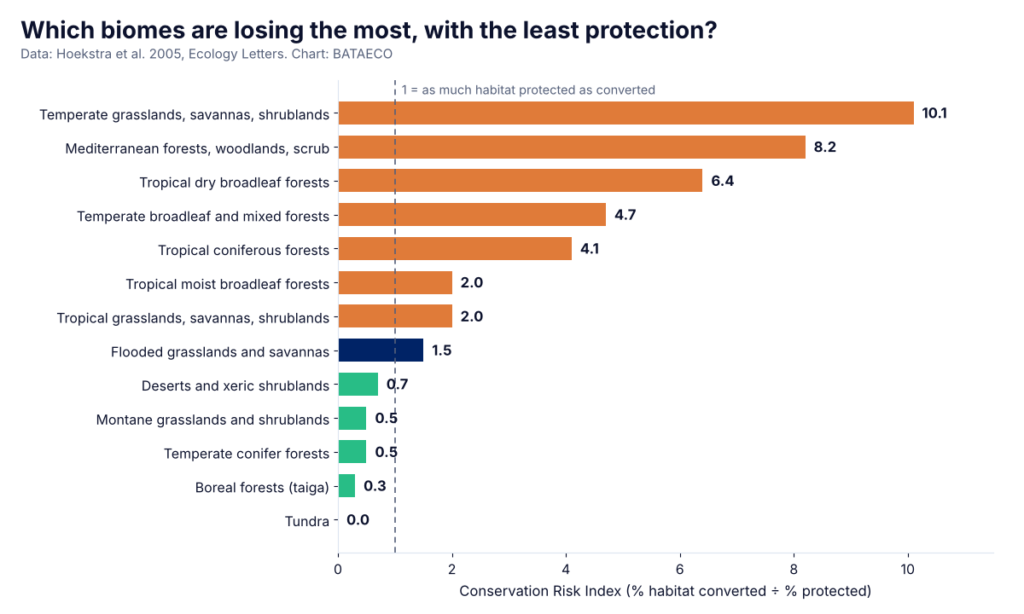
Species extinction gets most of the attention, but whole biomes can be lost too. To see which ones are most at risk, I charted the data from a global analysis by Hoekstra and colleagues, published in Ecology Letters in 2005. They compared, for each terrestrial biome, the share of habitat converted to human use (farms, cities, pasture) with the share inside protected areas. Dividing one by the other gives a Conservation Risk Index. A value of 1 means as much habitat is protected as has been converted. Higher values mean loss is outpacing protection.
What the data shows:
- Temperate grasslands, savannas and shrublands are the most endangered biome on Earth, with an index of 10.1. For every hectare protected, about ten have been converted, mostly to cropland.
- Mediterranean shrublands (chaparral) come second at 8.2. The authors note that conversion exceeds protection by roughly 8 to 1 in both temperate grasslands and Mediterranean biomes.
- Seven of thirteen biomes have an index of 2 or higher, meaning at least twice as much habitat lost as protected. They include tropical dry forests and temperate broadleaf forests.
- The cold biomes are in the best shape. Boreal forest (0.3) and tundra (0.0) are still mostly intact, simply because they are hard to farm.
My take as a biologist: the biomes most at risk are not the ones most people worry about. Rainforests deserve their attention, yet temperate grasslands and Mediterranean shrublands are in worse shape relative to how little of them is protected. The pattern follows agriculture. The same deep, fertile grassland soils described above made these biomes ideal for farming, so they were converted first. One limit of the index: it measures habitat area, not quality, so a protected area that is poorly managed still counts as protected. Newer studies use updated maps, but the ranking of the most threatened biomes has stayed similar.
Frequently Asked Questions
How many types of biomes are there?
Most textbooks list eight major terrestrial biomes: tropical rainforest, savanna, desert, chaparral, temperate grassland, temperate forest, boreal forest and tundra, plus freshwater and marine aquatic biomes. More detailed systems, such as the one used in the Hoekstra study, split land into 13 or 14 biomes, for example separating tropical dry forests from tropical moist forests.
What is the largest biome?
On land, the boreal forest (taiga) is the largest terrestrial biome. Counting water, the marine biome is by far the largest, because oceans cover most of Earth’s surface.
What is the difference between a biome and an ecosystem?
An ecosystem is a community of organisms interacting with its environment, at any size. A biome is a large region that groups many ecosystems with a similar climate and similar vegetation.
Which biome is the most threatened?
Temperate grasslands, savannas and shrublands, according to the Conservation Risk Index, followed by Mediterranean shrublands. Both have lost far more habitat to farming than has been protected.
What determines which biome forms in an area?
Mainly yearly temperature and precipitation, followed by how rain is spread through the seasons, plus disturbances such as fire and grazing.
Sources
- Hoekstra, J. M., Boucher, T. M., Ricketts, T. H. and Roberts, C. (2005). Confronting a biome crisis: global disparities of habitat loss and protection. Ecology Letters 8: 23 to 29. doi.org/10.1111/j.1461-0248.2004.00686.x
- OpenStax Biology 2e, section 44.3, Terrestrial Biomes.
- University of California Museum of Paleontology, The World’s Biomes.

Erzsebet (Eli) Frey is a biologist with a BSc in Biology and an MSc in Ecology from the University of Belgrade. She has field and lab experience across Asia, the Middle East, Europe and South America and uses Python and machine learning on biological data. Based in Serbia, she writes BATAECO and also runs Simply Ecologist and Eco&Stylish.