
Genetic drift is a random change in how common an allele (a version of a gene) is in a population from one generation to the next. It happens because only some individuals reproduce, and which ones do is partly down to chance. In large populations those chance effects average out. In small populations they can wipe out genetic variation within a few generations. This guide explains genetic drift, the bottleneck effect, the founder effect, inbreeding depression, heterosis and outbreeding depression, with a simulation and a real conservation case study.
What Is Genetic Drift?
Imagine a population of beetles where half carry a green allele and half a brown one. If, purely by bad luck, more green beetles get stepped on before breeding, the next generation will have fewer green alleles. Nothing about being green was worse. The change was random. That is genetic drift.
Drift is one of the main forces of evolution, alongside natural selection, mutation and gene flow. The difference is that selection pushes allele frequencies in a direction that improves fitness, while drift pushes them at random. Over time drift has three predictable outcomes:
- Alleles are lost or fixed. Left long enough, an allele either disappears (frequency 0) or becomes the only version (frequency 1).
- Genetic variation falls. Each loss reduces heterozygosity, the share of individuals carrying two different alleles of a gene.
- Isolated populations become different. Separate populations drift in separate directions, even in identical environments.
The strength of drift depends on the effective population size, the number of individuals that actually pass genes to the next generation. This is often far smaller than the head count, because some individuals never breed and others breed a lot.
Simulation: How Population Size Changes Drift
To show this with numbers rather than words, I ran a simple genetic drift simulation using the Wright Fisher model, a standard model in population genetics. Each population starts with an allele at 50%, there is no selection, and each new generation is a random sample of the alleles in the previous one. I ran 12 replicate populations at three sizes for 100 generations.
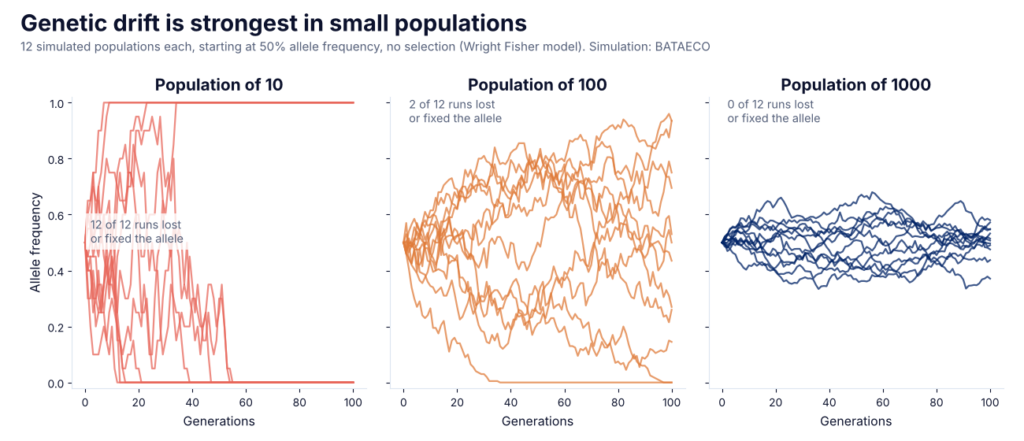
- Population of 10: all 12 runs ended with the allele either lost or fixed, most of them within 60 generations.
- Population of 100: the lines spread widely, and 2 of 12 runs lost the allele within 100 generations.
- Population of 1000: frequencies wobbled but stayed close to 50% in every run.
Same rules, same starting point. The only difference is size. This is why conservation biologists worry so much about small populations: they lose genetic variation by chance alone, even when nothing is selecting against it.
The Bottleneck Effect
A population bottleneck happens when a population crashes to a small number of survivors because of hunting, disease, habitat loss or a natural disaster. The survivors carry only a fraction of the original genetic variation, and if the population stays small, drift removes even more.
The northern elephant seal is a classic example. Commercial hunting in the 1800s reduced it to a tiny remnant, likely fewer than a hundred animals. The species has since recovered to large numbers, but genetic studies show very low variation, a lasting signature of the bottleneck. A bottleneck can end, but the lost alleles do not come back on their own; only mutation and gene flow restore them, and that takes a very long time.
The Founder Effect
The founder effect is a special case of drift that happens when a few individuals leave a large population and start a new one, for example on an island. The new population carries only the alleles the founders happened to have, often at very different frequencies from the source population.
Island species show this clearly, and so do some human communities. The Old Order Amish of Lancaster County, Pennsylvania, descend from a small group of founders, and a rare recessive condition called Ellis van Creveld syndrome is far more common there than in the general population. One founder carried the allele, and the small, closed population let it rise in frequency.
Inbreeding Depression
In small populations, individuals are more likely to mate with relatives. Inbreeding does not change allele frequencies by itself, but it increases the share of individuals that carry two copies of the same allele. Most populations carry rare harmful recessive alleles that stay hidden in heterozygotes. Inbreeding exposes them.
The result is inbreeding depression: lower survival, lower fertility, more birth defects and weaker immune systems. Drift and inbreeding feed each other. A small population loses variation through drift, which increases inbreeding, which lowers fitness, which keeps the population small. Conservation biologists call this the extinction vortex.
Heterosis (Hybrid Vigor)
Heterosis is the opposite of inbreeding depression. When two inbred lines are crossed, the offspring often grow larger, faster or healthier than either parent. Their genomes now carry two different alleles at many genes, so harmful recessives are masked again.
Plant breeders have used heterosis for about a century. Most commercial corn is hybrid seed made by crossing two inbred lines, because the hybrids yield much more than either parent. In conservation, the same principle is behind genetic rescue, described in the case study below.
Outbreeding Depression
Mixing populations is not always good. Outbreeding depression is a drop in fitness when individuals from genetically distant populations interbreed. It happens because populations adapt to local conditions, and crossing them can break up gene combinations that work well together, or produce offspring adapted to neither environment. The effect often shows up in the second generation, after the first hybrids breed with each other.
A well known example comes from the Tatra Mountains. After the native ibex were hunted out, ibex from Austria were reintroduced successfully. Later, ibex from Turkey and the Sinai were added. The hybrids rutted earlier in autumn, so kids were born in the middle of winter, and the population failed. The lesson for conservation is to move individuals between populations carefully, choosing sources from similar environments.
Case Study: Genetic Rescue of the Florida Panther
The Florida panther is the best documented case of a population pulled back from the extinction vortex. By the early 1990s, only about 20 to 30 adult and subadult panthers survived in southern Florida. They showed clear signs of inbreeding depression: kinked tails, cowlicks in the fur, a heart defect (atrial septal defect), undescended testicles, low sperm counts and poor sperm quality, heavy parasite loads and weak immune responses.
In 1995, managers released eight female pumas from Texas, a related population, into panther habitat. Five of the eight bred, producing 12 litters and at least 20 kittens.
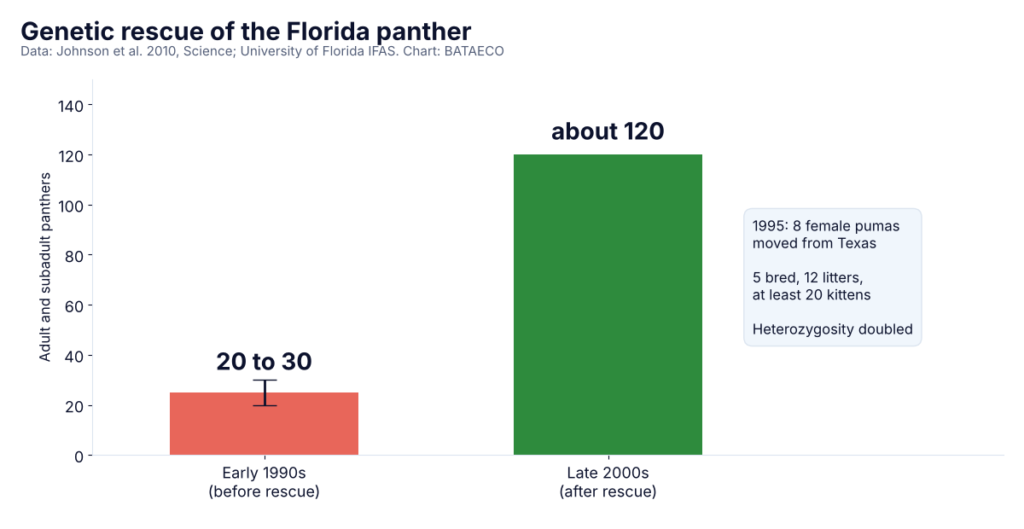
A 2010 study in Science by Johnson and colleagues assessed the results: panther numbers increased threefold, genetic heterozygosity doubled, survival and fitness improved, and signs of inbreeding declined significantly. University of Florida extension scientists report that the population grew from 20 to 30 animals to about 120.
My take as a biologist: this case links every idea in this guide. A small population lost variation through drift, inbreeding exposed harmful alleles, and fitness fell. Adding new alleles reversed it within a few panther generations, the same mechanism as heterosis. Outbreeding depression was a real risk, which is why managers chose a neighboring subspecies and only eight animals. The authors also warn that the rescue does not solve the root problem: continued habitat loss, persistent inbreeding, disease and limited space mean the population will need monitoring and possibly more gene flow in the future. Genetic rescue buys time; habitat is what keeps a population viable.
To see how these ideas fit into the bigger picture of evolution, read our guide to evolutionary biology concepts, and for how small populations end up on red lists, see the characteristics of threatened species.
Frequently Asked Questions
What is the difference between genetic drift and natural selection?
Natural selection changes allele frequencies because some alleles improve survival or reproduction. Genetic drift changes them at random, regardless of fitness.
What is the difference between the bottleneck effect and the founder effect?
In a bottleneck, an existing population crashes and the survivors stay in place. In the founder effect, a small group leaves to start a new population somewhere else. Both leave a small sample of the original genetic variation.
Why does genetic drift matter more in small populations?
Because each generation is a smaller sample of the previous one, so chance has a bigger effect. In the simulation above, every population of 10 lost or fixed the allele, while populations of 1000 barely changed.
Can genetic drift be reversed?
Lost alleles can only come back through mutation, which is very slow, or gene flow from another population. Genetic rescue, as in the Florida panther, deliberately adds gene flow.
Is inbreeding depression the same as genetic drift?
No. Drift changes allele frequencies; inbreeding changes how alleles are paired in individuals. They often happen together in small populations and make each other worse.
Sources
- Johnson, W. E. et al. (2010). Genetic restoration of the Florida panther. Science 329: 1641 to 1645. PubMed 20929847
- University of Florida IFAS Extension, Genetic restoration of the Florida panther.

Erzsebet (Eli) Frey is a biologist with a BSc in Biology and an MSc in Ecology from the University of Belgrade. She has field and lab experience across Asia, the Middle East, Europe and South America and uses Python and machine learning on biological data. Based in Serbia, she writes BATAECO and also runs Simply Ecologist and Eco&Stylish.