
A prokaryotic cell is a simple, single cell that has no nucleus and no membrane bound organelles. Its DNA floats in a region of the cytoplasm called the nucleoid. All bacteria and archaea are prokaryotes. Most are only 0.1 to 5.0 micrometers across, far smaller than plant or animal cells, yet they were the first life on Earth and still outnumber every other kind of cell. This guide explains prokaryotic cell structure with a labeled diagram, gives examples, compares prokaryotic and eukaryotic cells, and shares my own analysis of 30 bacterial genomes.
During my lab internship I spent long hours counting cells under a microscope, and the thing that stays with you is scale. A single drop can hold more living cells than there are people in a city, and the smallest of them are just specks at the edge of what the lens can resolve. Prokaryotes are those specks. Simple does not mean primitive, though. As you will see, a prokaryotic cell is one of the most efficiently packed machines in biology.
What Is a Prokaryotic Cell?
The word comes from Greek: pro means before and karyon means kernel, referring to the nucleus. A prokaryote is literally a cell from before the nucleus. Like every cell, it has the four basic components that OpenStax Biology lists for all cells: a plasma membrane, cytoplasm, DNA and ribosomes. What it lacks is the internal compartments of eukaryotic cells: no nucleus, no mitochondria, no endoplasmic reticulum, no Golgi apparatus, no chloroplasts.
Prokaryotes belong to two of the three domains of life:
- Bacteria, the familiar group that includes Escherichia coli, Streptococcus, cyanobacteria and the microbes in your gut. Most have a cell wall made of peptidoglycan.
- Archaea, which look similar under a microscope but differ chemically. Their cell walls lack peptidoglycan, their membranes are built from different lipids, and many live in extreme places such as hot springs, salt lakes and the guts of cattle, where some produce methane.
Prokaryotic Cell Structure (with Diagram)
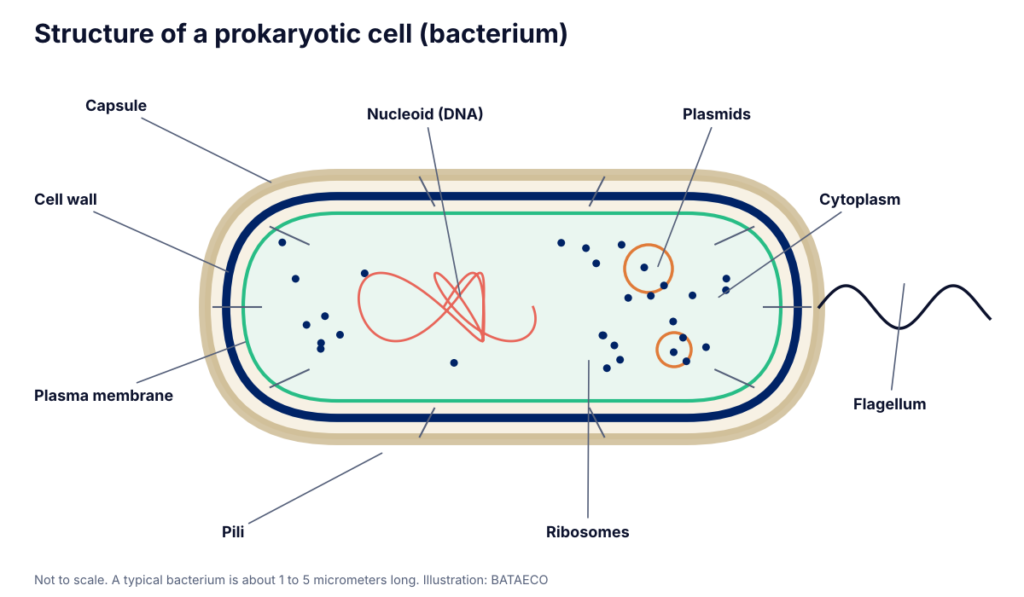
Working from the inside out, these are the main parts of a prokaryotic cell and what each one does:
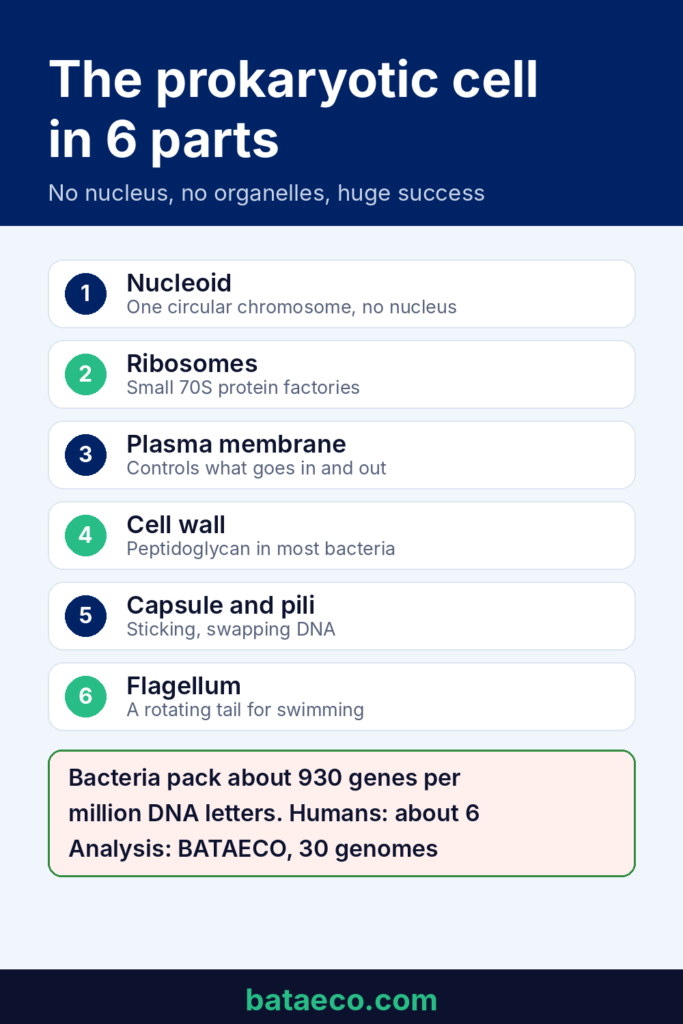
- Nucleoid: the region where the cell’s DNA sits, usually one circular chromosome, folded and packed but not enclosed by a membrane.
- Plasmids: small extra circles of DNA that replicate independently. They often carry useful genes, such as those for antibiotic resistance, and can be passed between cells.
- Ribosomes: the protein factories. Prokaryotic ribosomes are smaller (70S) than eukaryotic ones (80S), a difference that lets many antibiotics block bacterial protein synthesis without harming our own cells.
- Cytoplasm: the jelly like interior where all metabolism happens, since there are no organelles to divide the work.
- Plasma membrane: the barrier that controls what enters and leaves. In prokaryotes it also does jobs that organelles do in eukaryotes, including making energy.
- Cell wall: a rigid layer outside the membrane that gives shape and stops the cell from bursting. Most bacteria build it from peptidoglycan, and its thickness is what the Gram stain detects. Our guide to bacterial cell wall composition explains the Gram positive and Gram negative designs in detail.
- Capsule: a sticky outer layer of sugars in many bacteria that helps them attach to surfaces and hide from immune cells.
- Pili and fimbriae: hair like projections. Fimbriae help cells attach to surfaces and host cells, and pili can transfer DNA between cells during conjugation.
- Flagella: long whip like tails that rotate like propellers, letting many bacteria swim toward food and away from danger.
Not every prokaryote has all of these. The membrane, cytoplasm, ribosomes and DNA are universal; capsules, pili, flagella and plasmids vary from species to species.
Size and Shape of Prokaryotic Cells
Most prokaryotic cells measure 0.1 to 5.0 micrometers in diameter, while eukaryotic cells range from 10 to 100 micrometers. Small size is an advantage: as a cell grows, its volume increases faster than its surface area, so a small cell can move nutrients and wastes across its membrane quickly enough to serve its whole interior.
Common shapes give many bacteria their names:
- Cocci are spherical, like Staphylococcus and Streptococcus.
- Bacilli are rod shaped, like E. coli and Bacillus subtilis.
- Spirilla and spirochetes are spiral, like Treponema pallidum and Borrelia burgdorferi.
There are spectacular exceptions. In 2022, researchers described Thiomargarita magnifica in the journal Science, a bacterium from Caribbean mangrove swamps whose cells can be about a centimeter long, around 5,000 times larger than most bacteria and visible to the naked eye.
Examples of Prokaryotic Cells
- Escherichia coli: a gut bacterium and the workhorse of molecular biology labs.
- Streptococcus pneumoniae: a cause of pneumonia and the bacterium in which DNA was first shown to carry hereditary information.
- Staphylococcus aureus: common on skin; some strains are antibiotic resistant (MRSA).
- Mycobacterium tuberculosis: the cause of tuberculosis.
- Lactobacillus species: used to make yogurt and found in the human gut.
- Cyanobacteria such as Synechocystis: photosynthetic bacteria that added oxygen to Earth’s early atmosphere.
- Rhizobium: bacteria that fix nitrogen inside the root nodules of legumes.
- Methanogenic archaea: produce methane in wetlands and in the stomachs of cattle.
- Halophilic archaea such as Halobacterium: thrive in water many times saltier than the sea.
Prokaryotic vs Eukaryotic Cells
| Feature | Prokaryotic cell | Eukaryotic cell |
|---|---|---|
| Nucleus | No; DNA in a nucleoid | Yes, enclosed by a nuclear envelope |
| Membrane bound organelles | None | Mitochondria, ER, Golgi, chloroplasts in plants |
| DNA | Usually one circular chromosome, plus plasmids | Several linear chromosomes |
| Ribosomes | Smaller, 70S | Larger, 80S |
| Typical size | 0.1 to 5.0 µm | 10 to 100 µm |
| Cell division | Binary fission | Mitosis and meiosis |
| Organisms | Bacteria and archaea | Animals, plants, fungi, protists |
A simple way to remember the difference: pro sounds like “no”, so prokaryotes have no nucleus, while eukaryotes have a “true” nucleus. For how the two main kinds of eukaryotic cells differ from each other, see our comparison of plant cells vs animal cells.
The two cell types are also deeply connected. Mitochondria and chloroplasts carry their own small circular DNA and 70S type ribosomes, evidence that they began as free living bacteria that were engulfed by an ancestral cell, the idea known as endosymbiotic theory. In a real sense, every cell in your body carries a former prokaryote inside it.
How Prokaryotic Cells Reproduce and Share Genes
Prokaryotes reproduce by binary fission: the cell copies its chromosome, grows, and splits into two identical daughter cells. Under ideal conditions some bacteria, such as E. coli, can divide roughly every 20 minutes, which is why a few cells can become millions overnight.
Without sex, prokaryotes still mix genes through horizontal gene transfer:
- Transformation: taking up free DNA from the environment.
- Transduction: DNA carried from one cell to another by a virus that infects bacteria.
- Conjugation: direct transfer of DNA, often a plasmid, through a pilus connecting two cells.
These routes are how antibiotic resistance genes spread so quickly between bacteria, even between different species.
Case Study: How Tightly Do Prokaryotes Pack Their Genes?
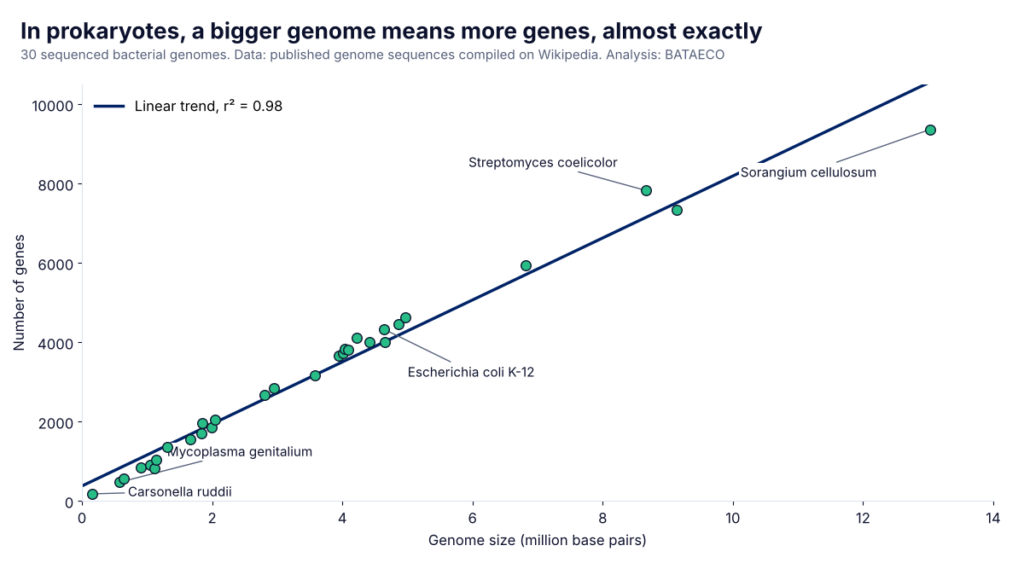
Textbooks say prokaryotic genomes are compact, but rarely show how compact. To measure it, I took genome size and gene counts for 30 sequenced bacteria, from the tiny insect symbiont Carsonella ruddii to the soil bacterium Sorangium cellulosum, using the published genome sequences compiled in Wikipedia’s list of sequenced bacterial genomes. Then I calculated the gene density of each genome and fitted a linear regression.
What the data shows:
- Genome size predicts gene number almost perfectly. The linear fit explains 98% of the variation (r² = 0.98). Double the genome and you roughly double the genes.
- About one gene per thousand DNA letters. The median density was 932 genes per million base pairs. Every genome in the set fell between 719 and 1,140 genes per million base pairs.
- The range in size is huge. Carsonella ruddii has about 160,000 base pairs and 182 genes; Sorangium cellulosum has about 13 million base pairs and 9,367 genes, more than fifty times as many.
- Compared with us: the human genome has about 3.1 billion base pairs, and GENCODE (release 49) reports 19,433 protein coding genes. That works out to roughly 6 genes per million base pairs, so bacteria pack their genes about 150 times more densely. This comparison is rough, since the bacterial counts include all annotated genes and the human figure only protein coding ones, but the gap is so large that the conclusion stands.
My take as a biologist: this is what “simple” really means for a prokaryote. Not crude, but ruthlessly economical. A bacterium copies its whole genome every time it divides, sometimes every 20 minutes, so every unnecessary letter costs time and energy. Natural selection has trimmed bacterial DNA down to little more than working genes, packed back to back. Eukaryotes took the opposite route, tolerating vast stretches of non coding DNA, much of it regulatory and much of it still poorly understood. The tiniest genomes in my dataset, such as Carsonella and Buchnera, belong to bacteria that live inside insect cells and have handed many jobs to their hosts, a reminder that a genome shrinks when life gets easier.
Why Prokaryotic Cells Matter
- They run the planet’s chemistry: fixing nitrogen, decomposing dead matter, cycling carbon and sulfur.
- They made the air breathable: photosynthetic cyanobacteria produced the oxygen that transformed Earth’s early atmosphere.
- They live in and on us: gut bacteria help digest food and train the immune system, while a minority cause disease.
- They are biotechnology’s factories: engineered E. coli produce human insulin and many other medicines, enzymes and research tools.
Recommended Resources
If you want to see prokaryotic cells for yourself, a compound microscope with 1000x oil immersion is the minimum for bacteria; lower magnifications will show only colonies. For a full university level reference, Brock Biology of Microorganisms is the standard microbiology textbook. As an Amazon Associate, BATAECO earns from qualifying purchases.
Frequently Asked Questions
Do prokaryotic cells have a nucleus?
No. Their DNA sits in the nucleoid, a region of the cytoplasm without a surrounding membrane.
Are human cells prokaryotic?
No. Human cells are eukaryotic, with a nucleus and organelles. However, the human body hosts trillions of prokaryotic cells, mainly bacteria in the gut.
Are prokaryotic cells simple?
Structurally yes, compared with eukaryotic cells, but they are highly efficient. They carry out the same core chemistry of life with compact genomes and no internal compartments, and they thrive in nearly every environment on Earth.
Do prokaryotic cells have ribosomes and mitochondria?
They have ribosomes (smaller 70S ribosomes) but no mitochondria. They make energy at their plasma membrane instead.
How do you remember prokaryotic vs eukaryotic?
“Pro” sounds like “no”: prokaryotes have no nucleus. “Eu” sounds like “true”: eukaryotes have a true nucleus.
What are examples of prokaryotic cells?
Bacteria such as E. coli, Streptococcus, Staphylococcus, Lactobacillus and cyanobacteria, and archaea such as methanogens and halophiles.
Sources
- OpenStax Biology 2e, Prokaryotic Cells.
- Genome sizes and gene counts: List of sequenced bacterial genomes, compiled from the original genome publications. Human gene count: GENCODE release 49.
- NPR (2022), Largest known bacterium, Thiomargarita magnifica, reporting Volland et al. in Science.

Erzsebet (Eli) Frey is a biologist with a BSc in Biology and an MSc in Ecology from the University of Belgrade. She has field and lab experience across Asia, the Middle East, Europe and South America and uses Python and machine learning on biological data. Based in Serbia, she writes BATAECO and also runs Simply Ecologist and Eco&Stylish.