
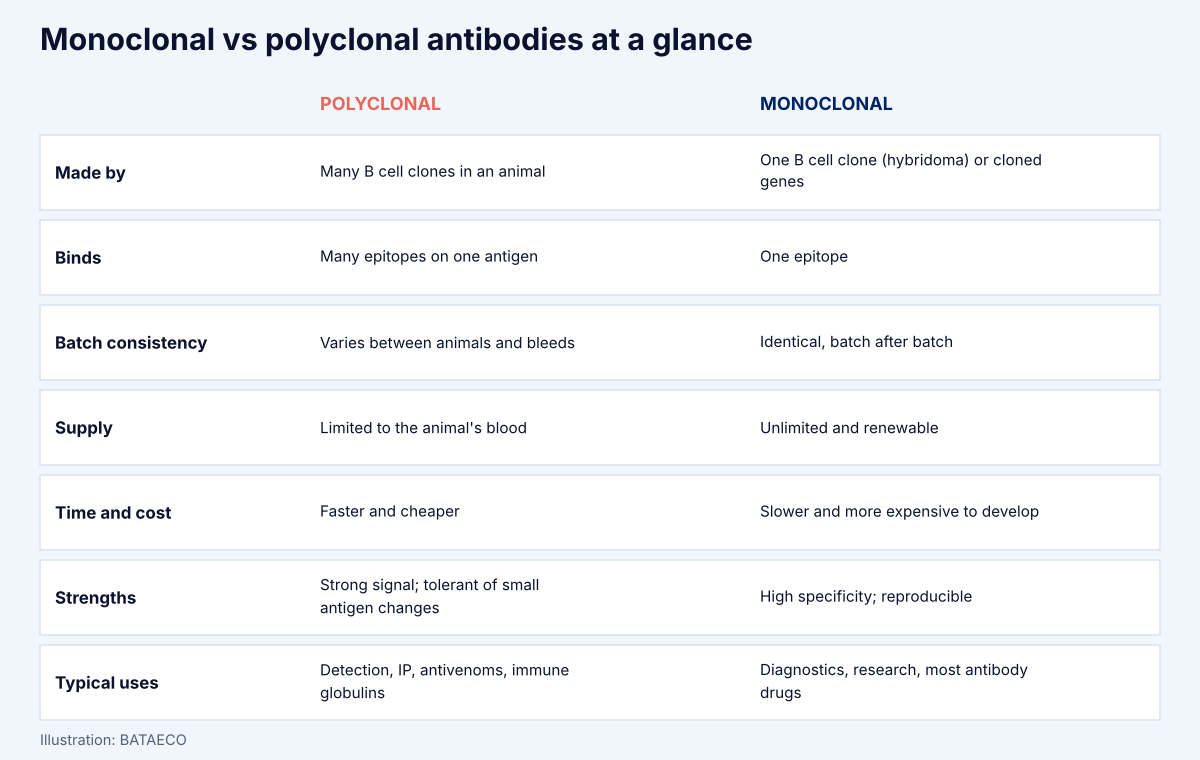
The difference between monoclonal and polyclonal antibodies comes down to their origin: polyclonal antibodies are a mixture made by many different B cells in an immunized animal, so they recognize many different spots (epitopes) on an antigen, while monoclonal antibodies come from a single B cell clone and all recognize the same single epitope. Polyclonal antibodies are fast, cheap and give strong signals; monoclonal antibodies are specific, consistent and renewable. This guide compares monoclonal vs polyclonal antibodies side by side, explains how each is made, where each is used, and what a large independent study found when it tested 614 commercial antibodies.
Polyclonal vs Monoclonal: The Core Difference
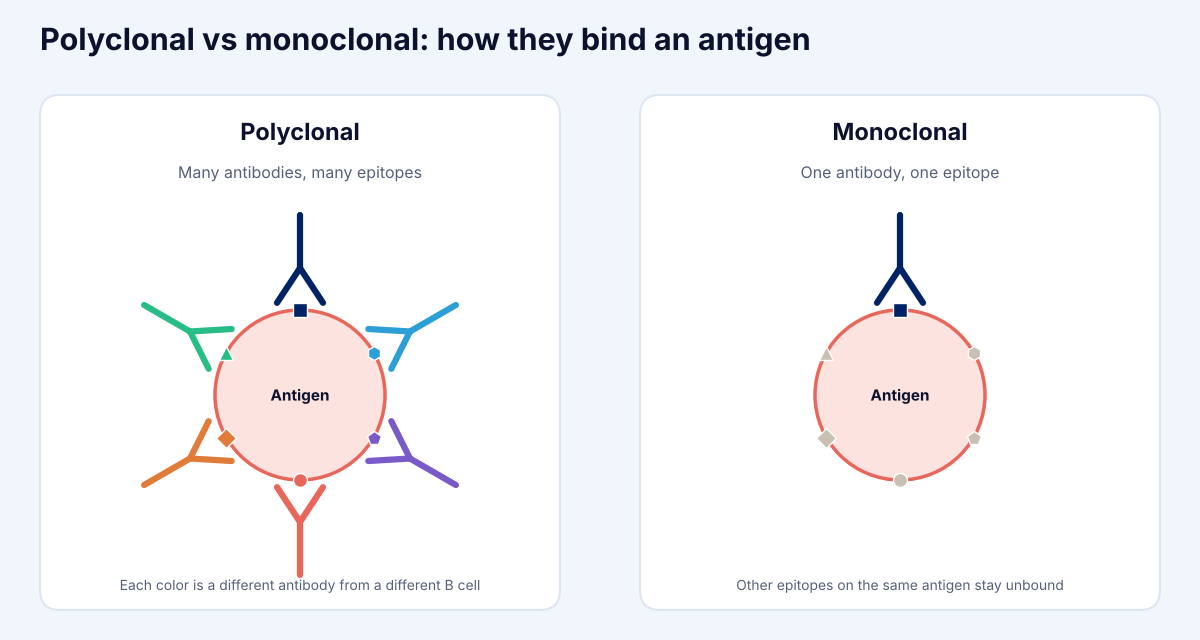
When an animal meets an antigen, many different B cells respond. Each B cell makes antibodies against one epitope, so the animal’s blood ends up with a mix of antibodies against many epitopes on the same antigen. That natural mix is a polyclonal antibody preparation.
A monoclonal antibody is what you get when you isolate just one of those B cells, make it immortal, and grow it into a clone. Every antibody it produces is identical, with the same structure and the same binding site. If you need a refresher on that binding site, see our guide to antibody structure.
How Polyclonal Antibodies Are Made
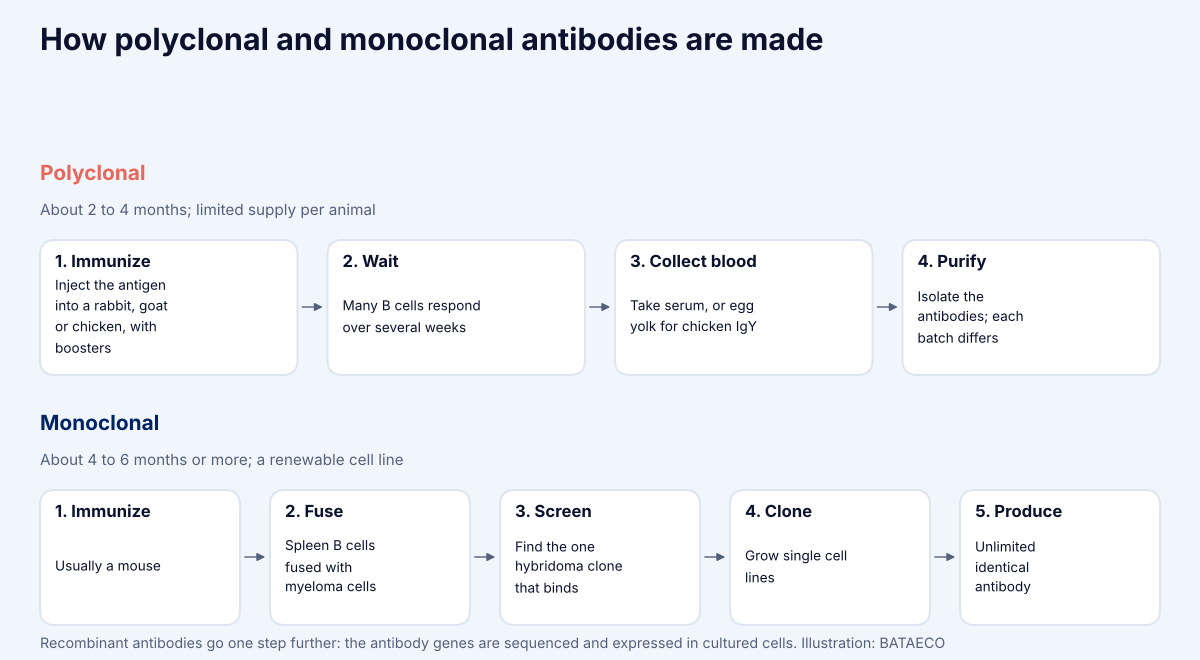
An animal, most often a rabbit, but also goats, sheep, donkeys, horses or chickens, is injected with the antigen, usually mixed with an adjuvant to boost the response, followed by several booster injections over weeks. Blood is then collected and the serum (or, for chickens, the egg yolk, which contains the antibody class IgY) is purified. The whole process takes roughly two to four months.
The catch is that every animal responds differently, and even the same animal makes a slightly different mix over time. When the animal’s supply runs out, a new animal will produce a new, different antibody preparation.


How Monoclonal Antibodies Are Made
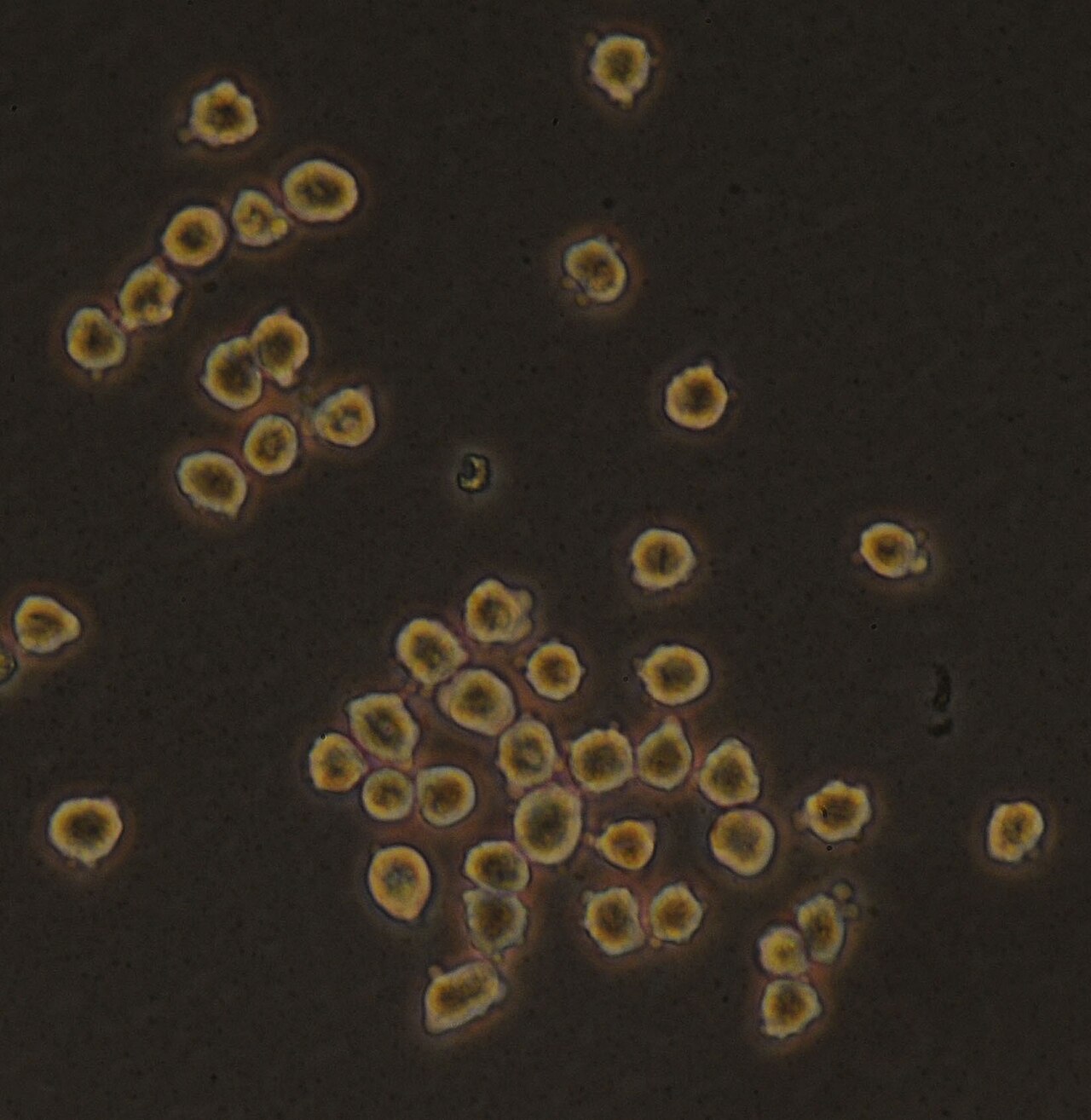
In 1975, Georges Köhler and César Milstein fused antibody producing B cells from an immunized mouse with immortal myeloma (cancer) cells. The resulting hybrid cells, called hybridomas, both make antibody and divide indefinitely. After screening hundreds of clones to find the one that binds the target best, that single clone can be grown forever, producing unlimited identical antibody. Köhler and Milstein shared the 1984 Nobel Prize in Physiology or Medicine with immunologist Niels Jerne. The full process, from hybridoma to bioreactor, is explained in our guide to how monoclonal antibodies are produced.
Recombinant antibodies: the third option
Today many antibodies are recombinant: the genes encoding the heavy and light chains are sequenced and expressed in cultured cells, such as CHO or HEK293 cells. A recombinant antibody is defined by its DNA sequence, so it can be reproduced exactly anywhere, engineered, or humanized for use as a drug. Many recombinant antibodies are monoclonal by origin, but a hybridoma can drift or die, while a sequence cannot.
Advantages and Disadvantages
Polyclonal antibodies
- Pros: quick and inexpensive to make; strong signals because several antibodies bind each antigen molecule; tolerant of small changes in the antigen, such as partial unfolding or a mutation in one epitope; good at capturing proteins in immunoprecipitation.
- Cons: batch to batch variation; higher risk of cross reactivity with similar proteins; limited supply; animal use for every new batch.
Monoclonal antibodies
- Pros: high specificity for one epitope; identical batches; unlimited supply; suitable for standardized diagnostics and therapy.
- Cons: slower and more expensive to develop; can fail if its single epitope is hidden, altered or destroyed by sample processing; usually weaker signal than a polyclonal mix.
Case Study: Do Antibodies Do What the Label Says?
Many researchers have wasted months on antibodies that bind the wrong protein. To measure the problem, the YCharOS consortium tested 614 commercial antibodies against 65 human proteins. Each antibody was tested side by side in normal cells and in “knockout” cells in which the target gene had been deleted; a good antibody gives a signal only in the normal cells. Ayoubi and colleagues published the results in eLife in 2023, and I charted their comparison of 258 polyclonal, 165 monoclonal and 191 recombinant antibodies.
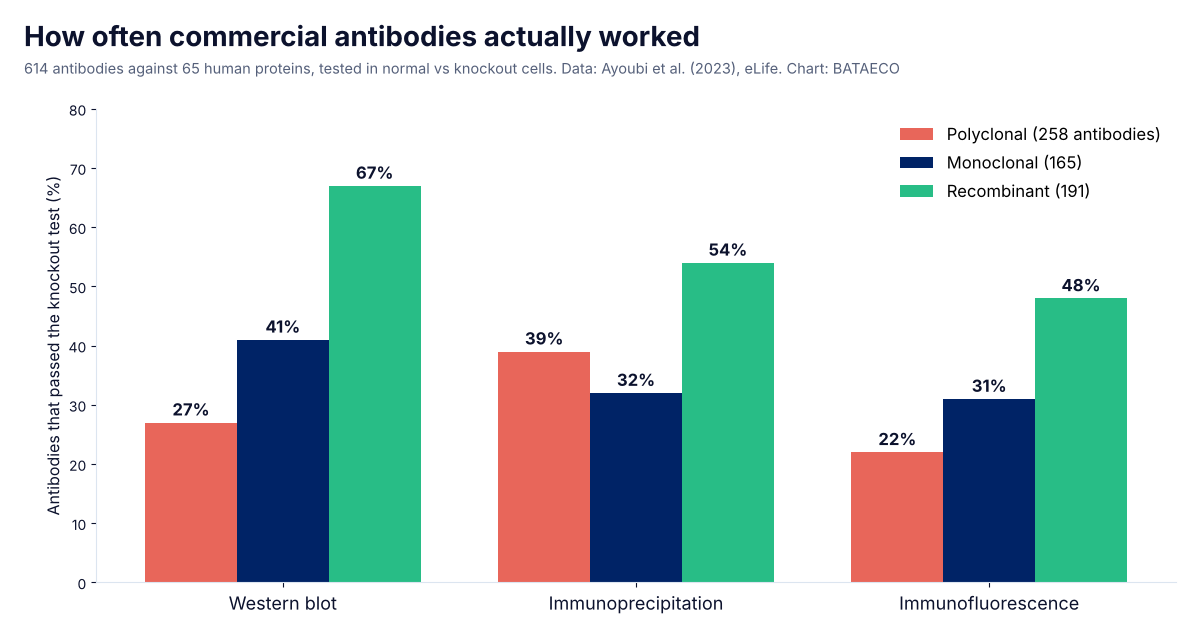
- Western blot: 27% of polyclonal, 41% of monoclonal and 67% of recombinant antibodies correctly detected their target.
- Immunoprecipitation: 39% of polyclonal, 32% of monoclonal and 54% of recombinant antibodies worked. This was the one test where polyclonals beat monoclonals.
- Immunofluorescence: 22% of polyclonal, 31% of monoclonal and 48% of recombinant antibodies gave a specific signal.
- Overall, more than 50% of all the antibodies tested failed in at least one application, and many of the failing antibodies had already been used in published studies.
My take as a biologist: two lessons stand out. First, the polyclonal versus monoclonal question matters less than whether an antibody has been properly validated: even the best category failed a third of the time in western blots. Second, the immunoprecipitation result makes biological sense. Pulling a folded protein out of a cell extract rewards an antibody mixture that can grab many surfaces, which is exactly the strength of a polyclonal. The authors point out that recombinant antibodies are newer and may have been characterized more carefully by suppliers, so part of their advantage may reflect better quality control rather than the format alone. Whatever you use, look for knockout or knockdown validation data before trusting it.
Where Each Type Is Used
- Monoclonal antibodies: almost all antibody drugs, from cancer treatments to arthritis and migraine medicines; pregnancy and rapid diagnostic tests; flow cytometry; blood typing reagents; most standardized research assays.
- Polyclonal antibodies: research detection and immunoprecipitation; secondary antibodies used to detect other antibodies; snake antivenoms raised in horses or sheep; human immune globulins (such as rabies or hepatitis B immune globulin) and pooled immunoglobulin from donated plasma.
As an Amazon Associate, BATAECO earns from qualifying purchases.
Frequently Asked Questions
What is the main difference between monoclonal and polyclonal antibodies?
Polyclonal antibodies are a mixture from many B cells that recognize many epitopes; monoclonal antibodies come from one B cell clone and recognize a single epitope.
Which is better, monoclonal or polyclonal?
It depends on the job. Monoclonals are better for specificity and reproducibility; polyclonals are often better for sensitive detection and capturing native proteins. Validation data matter more than the label.
Are therapeutic antibodies monoclonal or polyclonal?
Almost all modern antibody drugs are monoclonal (their names end in “mab”). Some older treatments, like antivenoms and immune globulins, are polyclonal.
Why are polyclonal antibodies cheaper?
They only require immunizing an animal and purifying its serum, without the months of cell fusion, screening and cloning needed for monoclonals.
What is a recombinant antibody?
An antibody produced from its cloned genes in cultured cells. It is defined by its DNA sequence, which makes it perfectly reproducible.
Sources
- Lipman, N. S. et al. (2005). Monoclonal versus polyclonal antibodies: distinguishing characteristics, applications, and information resources. ILAR Journal 46(3): 258 to 268. PubMed
- Ayoubi, R. et al. (2023). Scaling of an antibody validation procedure enables quantification of antibody performance in major research applications. eLife 12. doi.org/10.7554/eLife.91645
- The Nobel Prize, The Nobel Prize in Physiology or Medicine 1984.

Erzsebet (Eli) Frey is a biologist with a BSc in Biology and an MSc in Ecology from the University of Belgrade. She has field and lab experience across Asia, the Middle East, Europe and South America and uses Python and machine learning on biological data. Based in Serbia, she writes BATAECO and also runs Simply Ecologist and Eco&Stylish.