
A food chain is a single, straight path that shows who eats whom, while a food web is a network of many connected food chains in an ecosystem. Both show how energy moves from producers to consumers. Food chains are useful for teaching one pathway at a time; food webs show how real ecosystems work, where most animals eat several foods and are eaten by several predators. This guide explains the difference between a food chain and a food web, how organisms get their energy, and how much energy actually reaches the top, using real data from Silver Springs, Florida.
How Do Organisms Get Energy?
Almost all energy in living things starts as sunlight. Organisms get it in one of two ways:
- Autotrophs (producers) make their own food. Plants, algae and cyanobacteria capture light energy in photosynthesis and store it in sugars. In deep sea vents and caves, some bacteria use chemical energy instead, a process called chemosynthesis.
- Heterotrophs (consumers) get energy by eating other organisms. Herbivores eat producers, carnivores eat other animals, omnivores eat both, and decomposers such as fungi and bacteria break down dead material.
Inside cells, both groups release the stored energy through cellular respiration. Every time one organism eats another, some of that energy is passed on, but most is used for living or lost as heat. That loss is why food chains are short.
What Is a Food Chain?
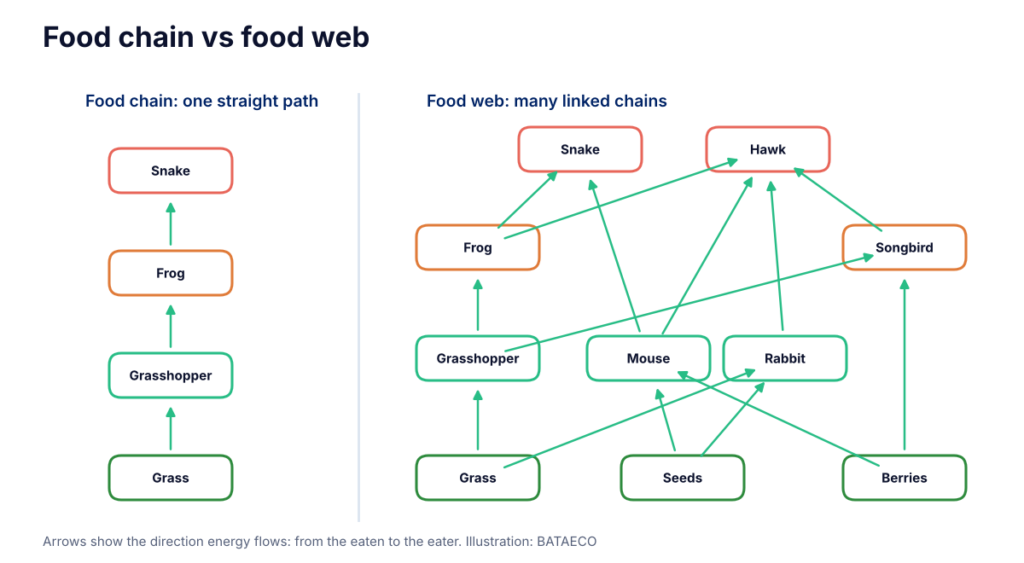
A food chain is a linear sequence showing how energy passes from one organism to the next. Each step is called a trophic level:
- Producers (grass, algae, phytoplankton)
- Primary consumers that eat producers (grasshopper, zooplankton)
- Secondary consumers that eat primary consumers (frog, small fish)
- Tertiary consumers that eat secondary consumers (snake, larger fish)
- Apex predators at the top (hawk, shark)
Example: grass, then grasshopper, then frog, then snake. Arrows in a food chain point in the direction energy flows, from the organism eaten to the organism that eats it. Decomposers act at every level, returning nutrients to the soil or water for producers to reuse.
What Is a Food Web?
A food web combines all the food chains in an ecosystem into one network. In the real world, a frog does not eat only grasshoppers, and grasshoppers are not eaten only by frogs. A food web shows those overlapping links: the mouse that eats seeds and berries, the hawk that eats mice, rabbits and songbirds, and so on.
Food Chain vs Food Web: Key Differences
| Feature | Food chain | Food web |
|---|---|---|
| Structure | One straight path | Network of many interlinked chains |
| Feeding links | Each organism eats one thing and is eaten by one thing | Organisms eat and are eaten by several species |
| Realism | Simplified model | Closer to real ecosystems |
| Stability | Losing one species breaks the chain | Alternative food sources buffer losses |
| Use | Teaching energy flow step by step | Studying ecosystem structure and resilience |
The stability point matters most. In a single food chain, removing the frog would starve the snake. In a food web, the snake can switch to mice. Ecosystems with more connections usually cope better with the loss of one species, although removing a highly connected species, a keystone species, can still cause large changes. For a marine example with many connections, see our guide to the coral reef ecosystem and its food web.
Case Study: How Much Energy Reaches the Top?
The ecologist Raymond Lindeman proposed in 1942 that energy transfer between trophic levels is inefficient, and his work led to the popular rule of thumb that about 10% of energy moves up each level. To test that against real measurements, I calculated the transfer between levels using one of the most famous field datasets in ecology: Howard Odum’s 1957 study of energy flow in Silver Springs, a spring fed river in Florida, as presented in OpenStax Biology.
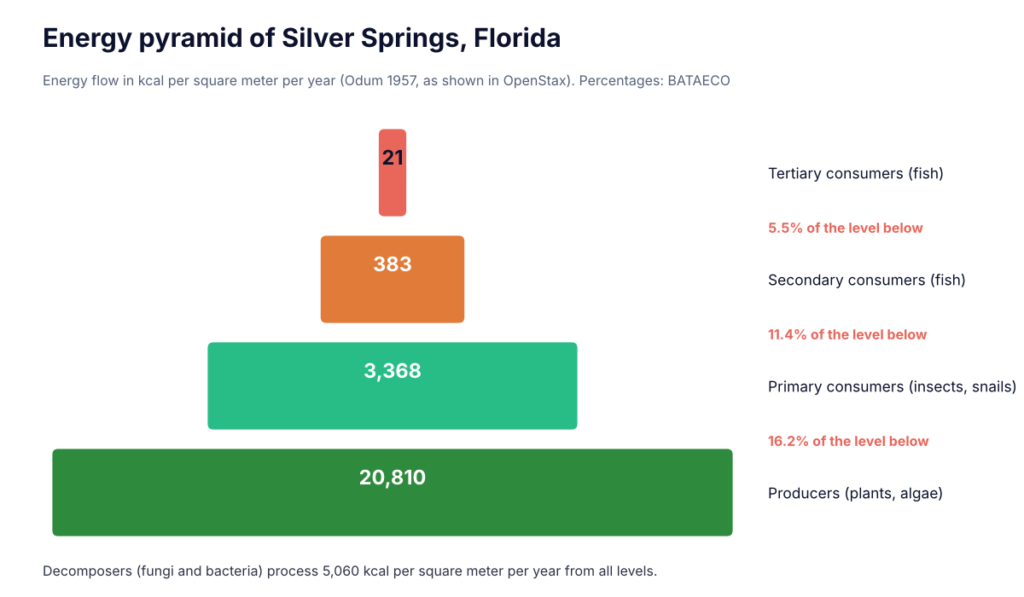
What the numbers show (kcal per square meter per year):
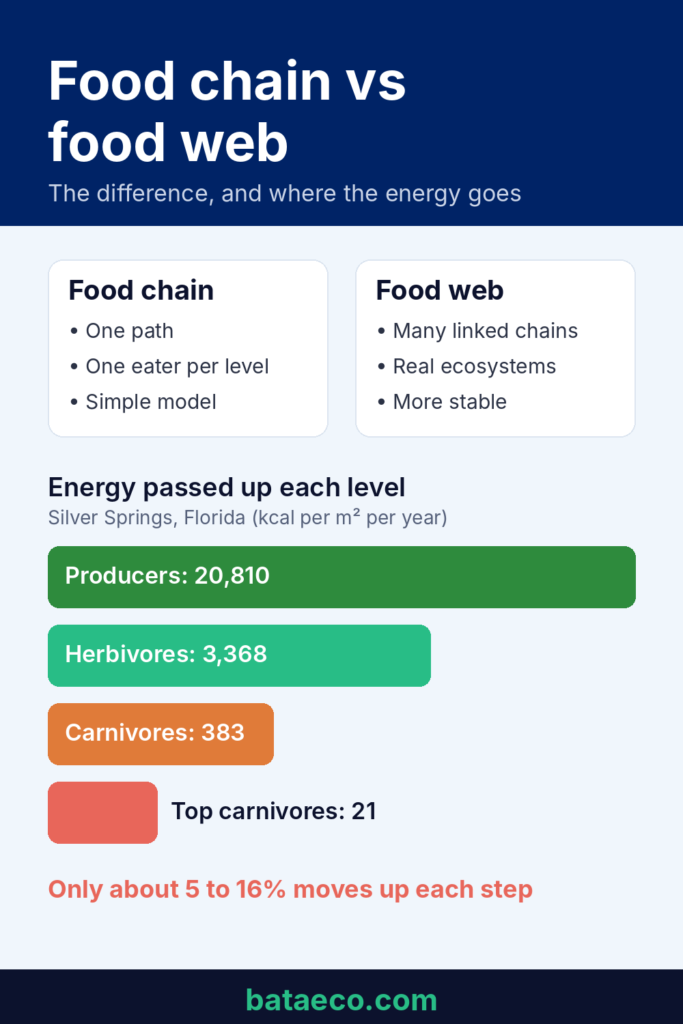
- Producers to primary consumers: 20,810 to 3,368, so about 16.2% of the energy moved up.
- Primary to secondary consumers: 3,368 to 383, about 11.4%.
- Secondary to tertiary consumers: 383 to 21, about 5.5%.
- Overall: the top carnivores received about 0.1% of the energy captured by the plants.
- Decomposers processed 5,060 kcal per square meter per year, more than all consumer levels combined.
OpenStax reports a transfer efficiency of about 14.5% between the first two levels using net production values, which is close to my 16.2% from the energy flow values in the pyramid. Both sit above the 10% rule, while the top step falls well below it.
My take as a biologist: the 10% rule is a useful memory aid, not a law. Real transfer efficiencies vary between roughly 5% and 20% depending on the organisms, because warm blooded predators burn far more energy on body heat than cold blooded fish or insects, and plant material is harder to digest than meat. The pattern that does hold everywhere is the steep drop in available energy at each step. It explains why food chains rarely have more than four or five levels, why top predators are always rare, and why removing them hits ecosystems so hard: there is very little energy to rebuild them.
For more on how energy shrinks at each level, see our full guide to the pyramid of energy.
Frequently Asked Questions
What is the main difference between a food chain and a food web?
A food chain shows one feeding path, while a food web shows all the overlapping feeding paths in an ecosystem.
Why are food webs more stable than food chains?
Because most consumers have several food sources. If one prey species declines, predators can switch to another, so the loss does not break the whole system.
Which direction do the arrows go in a food chain?
From the organism being eaten to the organism that eats it, showing the direction energy flows.
Why do food chains rarely have more than five levels?
Because only a small share of energy moves up each level. In Silver Springs, top carnivores received about 0.1% of the energy captured by plants, too little to support another level.
Where do decomposers fit in a food web?
Decomposers break down dead organisms and waste from every trophic level and return nutrients to producers, closing the loop.
Sources
- OpenStax Biology 2e, Energy Flow through Ecosystems (Silver Springs data from Odum 1957).
- Lindeman, R. L. (1942). The trophic dynamic aspect of ecology. Ecology 23: 399 to 417. doi.org/10.2307/1930126

Erzsebet (Eli) Frey is a biologist with a BSc in Biology and an MSc in Ecology from the University of Belgrade. She has field and lab experience across Asia, the Middle East, Europe and South America and uses Python and machine learning on biological data. Based in Serbia, she writes BATAECO and also runs Simply Ecologist and Eco&Stylish.