
Darwin’s theory of evolution states that all living species descend from common ancestors and change over generations through natural selection: individuals with traits that suit their environment survive and reproduce more, so those traits become more common. Charles Darwin published the idea in On the Origin of Species in 1859, and it remains the foundation of modern biology. This guide explains who Darwin was, what he is famous for, how natural selection works in four steps, the evidence for evolution, and a real case where scientists measured natural selection in Darwin’s finches.
Who Was Charles Darwin?
Charles Darwin (1809 to 1882) was an English naturalist. As a young man he studied medicine and then theology, but his real passion was collecting beetles and studying nature. In 1831 he joined HMS Beagle on a survey voyage that lasted almost five years and took him around South America, the Galápagos Islands, Australia and back to England in 1836.
On the voyage he collected fossils of giant extinct mammals, saw how species changed from one region to the next, and noticed that animals on the Galápagos Islands resembled those on the nearby South American mainland, yet differed from island to island. Back home he spent more than twenty years building evidence, breeding pigeons, studying barnacles and corresponding with naturalists around the world.
What Is Darwin Famous For?
- The theory of evolution by natural selection, published in On the Origin of Species in 1859.
- Common descent: the idea that all life is related through a branching tree of ancestors, which he sketched in his notebooks as a simple branching diagram.
- The Beagle voyage and his observations in the Galápagos Islands.
- Sexual selection, explained in The Descent of Man (1871), which accounts for traits such as the peacock’s tail that help in finding mates rather than surviving.
- Detailed natural history on barnacles, orchids, earthworms and plant movement that is still cited today.
Darwin was not the only one to reach the idea. Alfred Russel Wallace, working in Southeast Asia, independently came to the same conclusion and wrote to Darwin in 1858. Their ideas were presented together at the Linnean Society of London that year, and Darwin published the full argument the following year.
How Natural Selection Works: The Four Steps
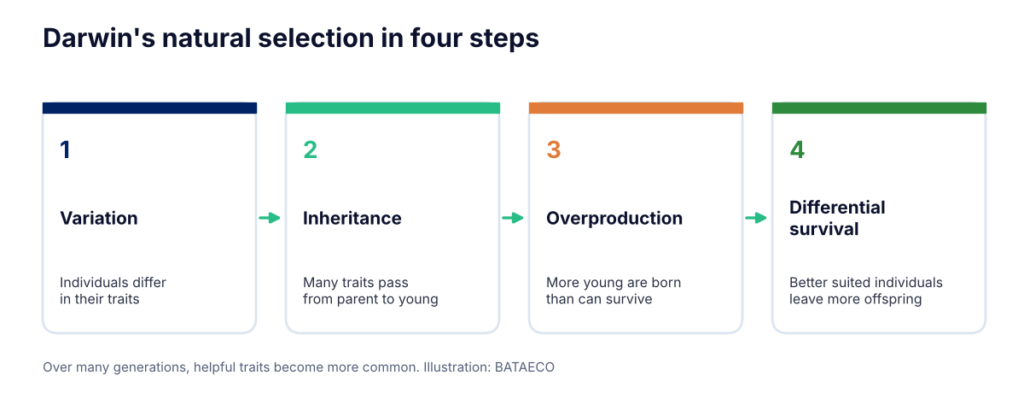
- Variation: individuals in a population differ in size, color, behavior and many other traits.
- Inheritance: many of those differences are passed from parents to offspring.
- Overproduction: organisms produce more offspring than the environment can support, so there is competition for food, space and mates. Darwin took this idea from the economist Thomas Malthus.
- Differential survival and reproduction: individuals whose traits suit the environment survive and reproduce more, passing those traits on.
Repeat this over many generations and populations change, becoming better adapted to their environment. When populations are separated and adapt in different directions, they can eventually become separate species. Darwin drew on artificial selection as a model: breeders had created very different pigeon, dog and crop varieties simply by choosing which individuals to breed.
The phrase “survival of the fittest” was coined by the philosopher Herbert Spencer, not Darwin, although Darwin later used it. In biology, “fittest” means best at surviving and reproducing in a given environment, not strongest.
Evidence for Darwin’s Theory
- Fossils show life changing over time, with transitional forms such as early whales with legs and feathered dinosaurs.
- Homologous structures: the same bones arranged in a human arm, a bat wing and a whale flipper point to a shared ancestor.
- Biogeography: island species resemble those on the nearest mainland, as Darwin saw in the Galápagos.
- Embryology: embryos of related animals look similar in early stages.
- DNA: genetic similarity between species matches the branching tree predicted by common descent.
- Observed evolution: antibiotic resistance in bacteria, pesticide resistance in insects and measured changes in wild populations, like the finches below.
What Darwin Got Wrong, and What Came Next
Darwin did not know how traits were inherited. He favored a blending theory, which would actually dilute variation. Gregor Mendel’s work on pea plants, published in 1866 but largely ignored until 1900, provided the answer: discrete units of inheritance, now called genes. In the 1930s and 1940s, biologists combined Darwin’s natural selection with Mendelian genetics in what is called the modern synthesis. It also added other forces Darwin did not fully describe, such as mutation, gene flow and genetic drift, the random change in allele frequencies that matters most in small populations.
Case Study: Measuring Natural Selection in Darwin’s Finches
Darwin assumed natural selection was too slow to see. Peter and Rosemary Grant proved otherwise. Starting in 1973 they measured almost every medium ground finch on the tiny Galápagos island of Daphne Major, year after year.
In 1977 a severe drought hit the island. Plants produced few seeds, small soft seeds became very rare, and only large seeds with tough husks remained. The finch population fell from about 1,400 birds to a few hundred in just over two years. Birds with deeper, stronger beaks could crack the big seeds and survived far more often.
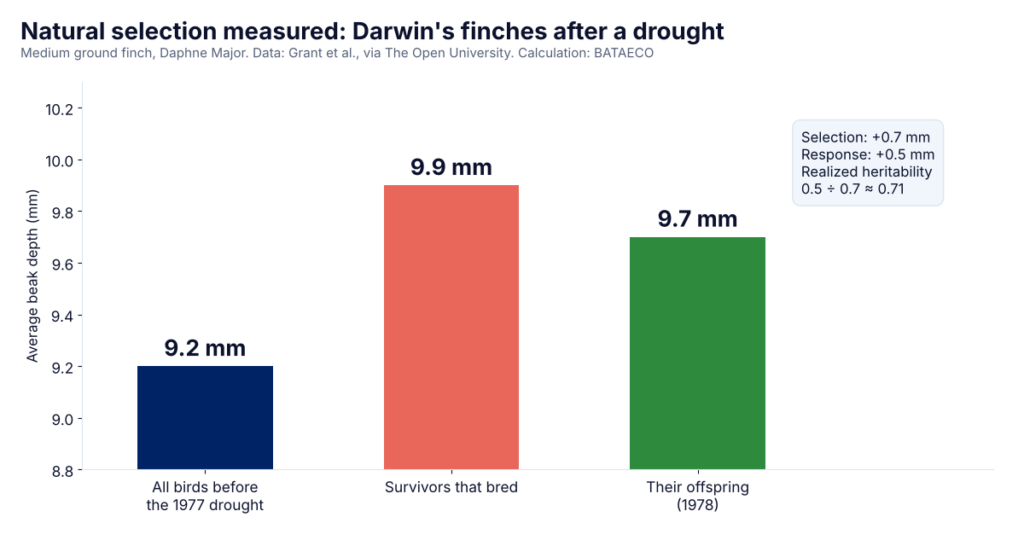
Using the figures reported by The Open University from the Grants’ studies, I calculated what happened:
- Before the drought, the average beak depth of all birds was 9.2 mm.
- The survivors that bred averaged 9.9 mm, about 0.7 mm (7.6%) deeper. This difference is the strength of selection.
- Their offspring in 1978 averaged 9.7 mm, about 0.5 mm (5.4%) deeper than the original population. This is the evolutionary response in a single generation.
- Realized heritability is the response divided by the selection: 0.5 ÷ 0.7 ≈ 0.71. In other words, about 71% of the selected difference was passed on to the next generation, which fits the strong parent and offspring resemblance in beak depth that the Grants recorded.
My take as a biologist: this is natural selection exactly as Darwin described it, with all four steps visible: beaks varied, beak size is heritable, far more birds hatched than the drought could feed, and the deep beaked birds left more offspring. The surprise is the speed: a measurable change in one generation. The Grants also showed that selection can reverse. After wet years brought back small seeds, smaller beaks were favored again. Evolution is not a march toward one perfect form; it tracks a changing environment.
To see how Darwin’s ideas connect to the rest of modern evolutionary theory, read our overview of evolutionary biology concepts.
Frequently Asked Questions
What is Darwin’s theory of evolution in simple terms?
Living things change over many generations because individuals with helpful inherited traits survive and reproduce more, so those traits spread. All species share common ancestors.
What are the main points of Darwin’s theory?
Variation, inheritance, overproduction and differential survival, which together produce natural selection, plus the idea of common descent.
When did Darwin publish his theory?
On the Origin of Species was published on 24 November 1859, a year after Darwin and Wallace’s ideas were presented at the Linnean Society.
Did Darwin say humans evolved from monkeys?
No. He argued that humans and apes share a common ancestor, which is what modern genetics confirms. Living monkeys and apes are our cousins, not our ancestors.
Is evolution just a theory?
In science, a theory is a well tested explanation supported by large amounts of evidence, not a guess. Evolution is supported by fossils, DNA, anatomy and direct observation.
Sources
- The Open University, OpenLearn, Natural selection in Darwin’s finches (data from Grant and Grant 2000; Grant et al. 2003).
- Darwin Correspondence Project, University of Cambridge, darwinproject.ac.uk.

Erzsebet (Eli) Frey is a biologist with a BSc in Biology and an MSc in Ecology from the University of Belgrade. She has field and lab experience across Asia, the Middle East, Europe and South America and uses Python and machine learning on biological data. Based in Serbia, she writes BATAECO and also runs Simply Ecologist and Eco&Stylish.