
The oyster mushroom (Pleurotus ostreatus) is an edible, shelf shaped mushroom that grows on dead wood, with a smooth fan shaped cap, gills that run down onto a short stem, and a white to pale lilac spore print. It is one of the easiest mushrooms to grow at home and one of the most widely eaten in the world. Oyster mushrooms come in several types, including pearl, blue, golden, pink and king oyster. This guide covers how to identify oyster mushrooms and their lookalikes, how they compare nutritionally with other mushrooms, how to grow them, and one of the strangest facts in biology: oyster mushrooms hunt worms.
What Is an Oyster Mushroom?
Oyster mushrooms belong to the genus Pleurotus, a group of wood decaying fungi found on every continent except Antarctica. The name comes from the shape and color of the cap, which looks like an oyster shell. In the wild they grow on dying or dead hardwood trees, logs and stumps, especially beech, aspen, poplar and oak, and occasionally on conifers.
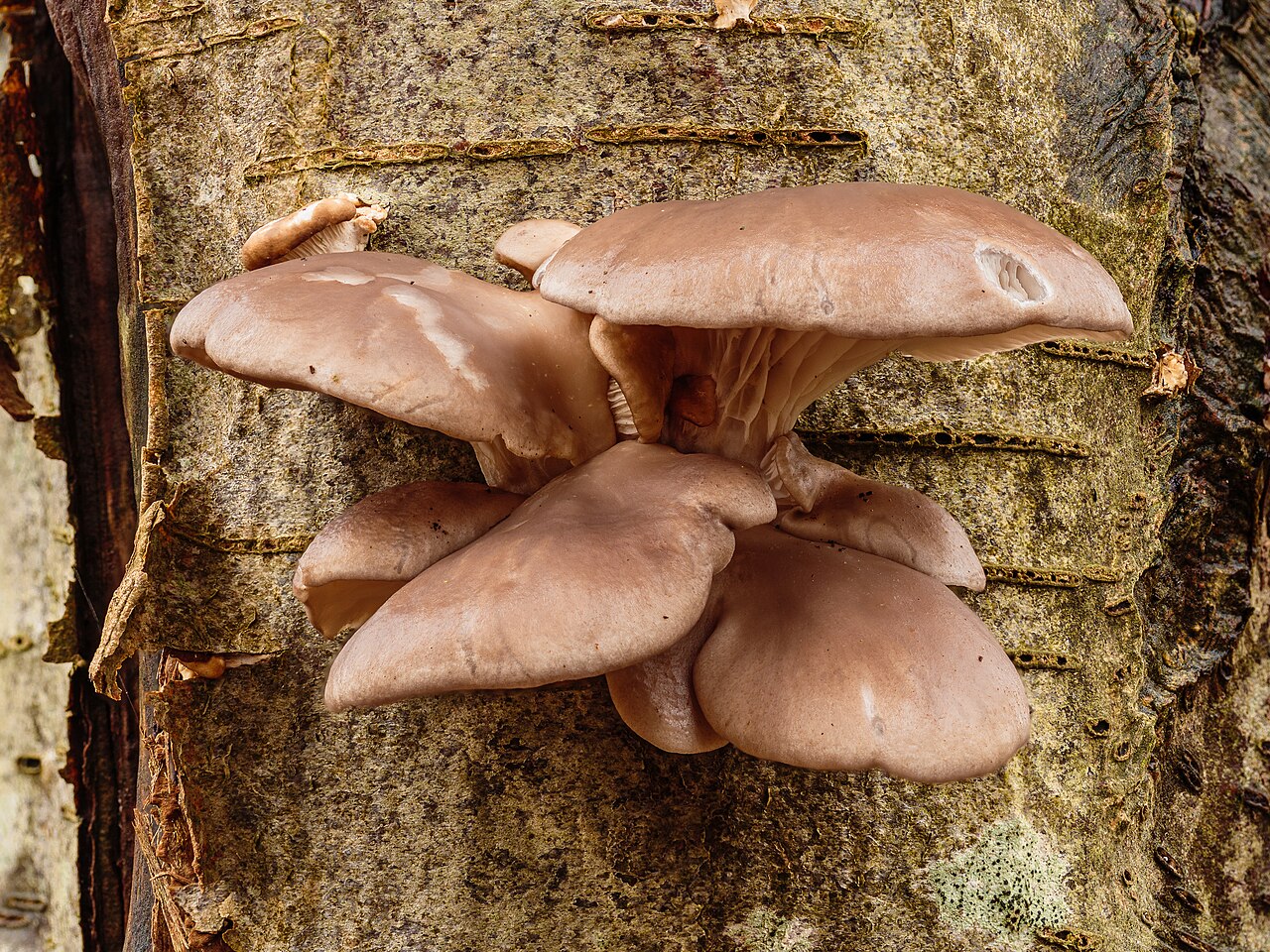
Like other white rot fungi, oyster mushrooms break down lignin and cellulose, the tough compounds in wood, and return their nutrients to the soil. This makes them important decomposers in forests, a role explained in our guide to decomposers. The same wood digesting enzymes let growers raise them on straw, sawdust, coffee grounds and other farm waste.
Types of Oyster Mushrooms
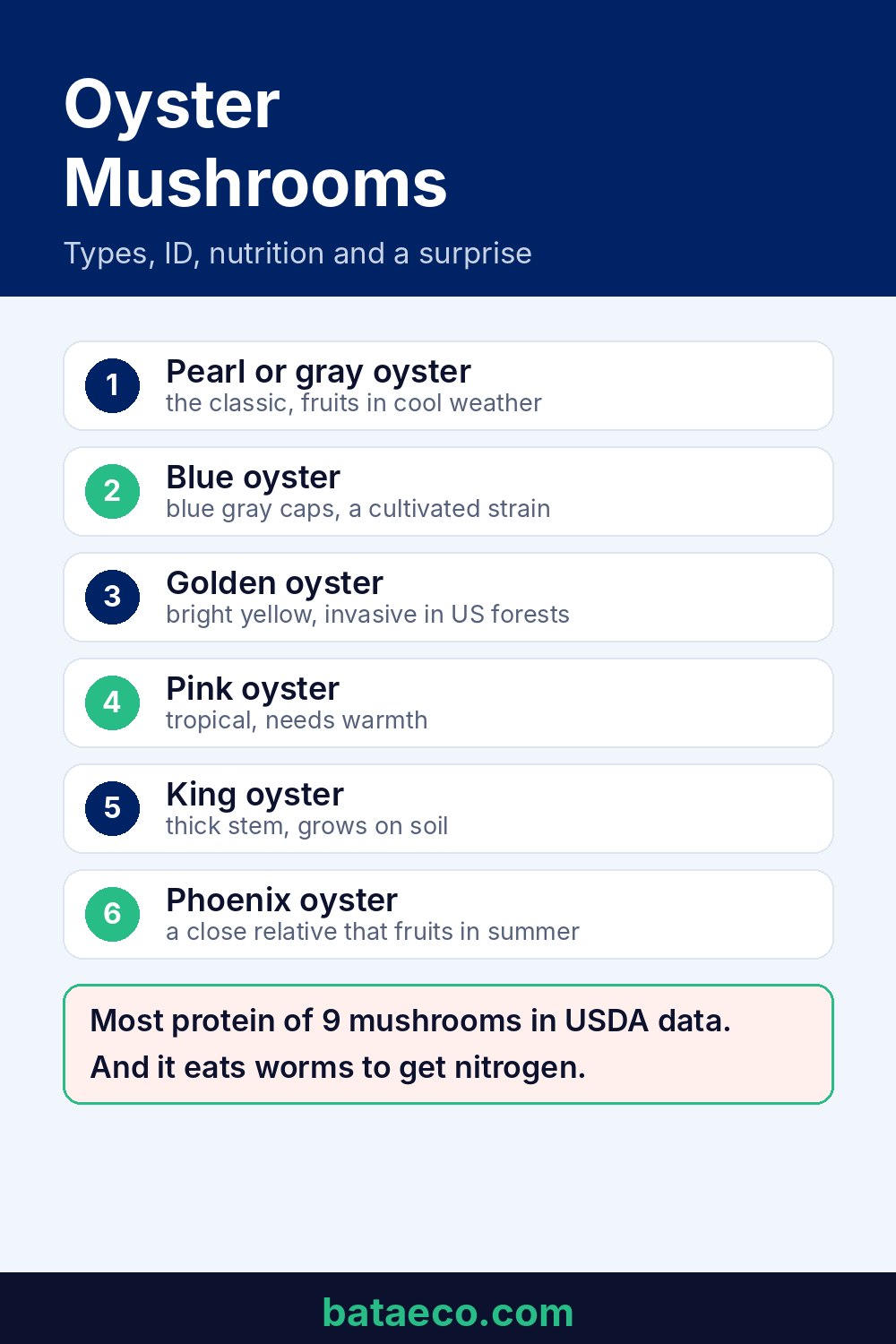
- Pearl or gray oyster (Pleurotus ostreatus): the classic species, with gray, tan or cream caps. It fruits in cool weather, from autumn into winter.
- Blue oyster: a cultivated strain of P. ostreatus with dark blue gray caps that fade to gray as they mature. Popular with home growers.
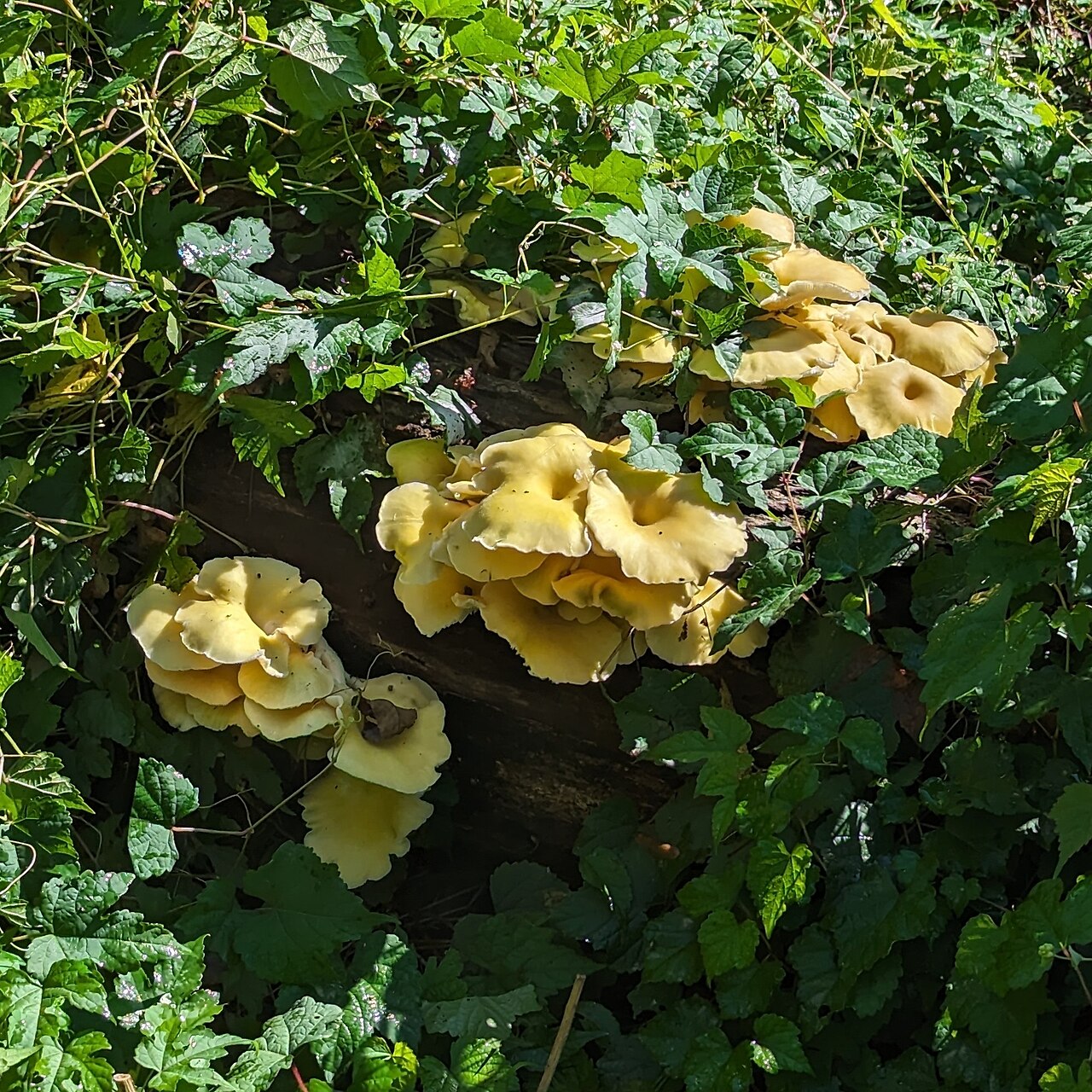
- Golden oyster (Pleurotus citrinopileatus): bright lemon yellow clusters, native to East Asia. It has escaped from cultivation in the United States and is now spreading through forests (see below).
- Pink oyster (Pleurotus djamor): vivid pink, tropical, and best grown in warm conditions. It loses most of its color when cooked.
- King oyster (Pleurotus eryngii): a thick, meaty white stem with a small cap. Unlike the others, in the wild it grows on soil, feeding on the roots of plants in the carrot family, mainly in the Mediterranean.
- Phoenix or Indian oyster (Pleurotus pulmonarius): very similar to the pearl oyster but fruits in warmer, summer weather.
- Aspen oyster (Pleurotus populinus): a North American species found mainly on aspen and poplar.
Oyster Mushroom Identification
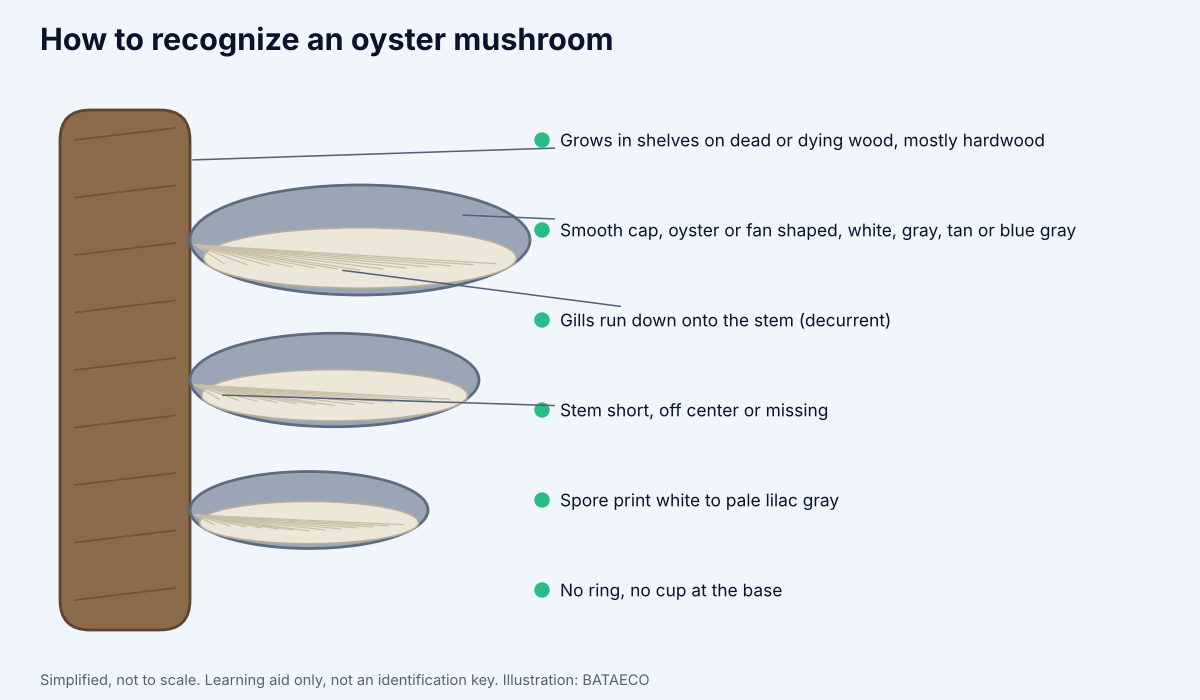
To tell an oyster mushroom, mycologists look at all of these features together:
- Growth on wood: overlapping shelves or clusters growing directly from trunks, logs or stumps.
- Cap: smooth, oyster or fan shaped, 5 to 25 cm across, white, gray, tan or brown.
- Gills: white to cream, crowded, and running down onto the stem (decurrent).
- Stem: short, thick and off center, or missing completely.
- Spore print: white to pale lilac gray, never brown or rusty.
- Smell: mild and pleasant, sometimes faintly like anise.
Oyster mushroom lookalikes
Oyster mushrooms are considered a fairly safe group to learn, but they do have lookalikes:
- Angel wings (Pleurocybella porrigens): thin, pure white, smaller caps on conifer wood. Long considered edible, it was linked to a fatal brain illness in Japan in 2004, mostly among people with kidney disease, and is now avoided.
- Ghost fungus and tsukiyotake (Omphalotus spp.): poisonous relatives of the jack o’lantern mushroom in Australia and East Asia that grow in oyster like shelves. They glow faintly in the dark and cause severe vomiting.
- Elastic oysterling (Crepidotus spp.): small, soft shelves on wood, told apart by a brown spore print.
- Mock oyster (Phyllotopsis nidulans): orange, hairy caps with a strong unpleasant smell.
- Train wrecker (Neolentinus lepideus) and Lentinellus spp.: tough or bitter wood decayers with jagged or scaly features.
As with any wild mushroom, never eat one unless an experienced local expert has identified it in person. Our guide to edible mushrooms and their toxic lookalikes explains why a single feature is never enough.
The Mushroom That Eats Worms
Dead wood is rich in carbon but poor in nitrogen, which every living thing needs to build proteins. Oyster mushrooms solve this problem by hunting. Their mycelium, the network of threads inside the wood, kills nematodes (tiny roundworms) and absorbs them as food. This carnivorous habit was first described by Canadian mycologists Thorn and Barron in 1984.
In 2023, researchers at Academia Sinica in Taiwan identified the weapon. The mycelium grows microscopic, lollipop shaped structures called toxocysts. When a nematode touches one, a volatile compound called 3-octanone is released, which paralyzes the worm and kills its cells within minutes. The fungus then grows into the body and digests it. So the oyster mushroom on your plate is the fruit of a predator.
Case Study: How Nutritious Are Oyster Mushrooms?
Health claims about oyster mushrooms are everywhere, so I went to the source. I pulled the official nutrient values for nine raw mushrooms from USDA FoodData Central (SR Legacy database) and compared oyster mushrooms with the others, per 100 g.
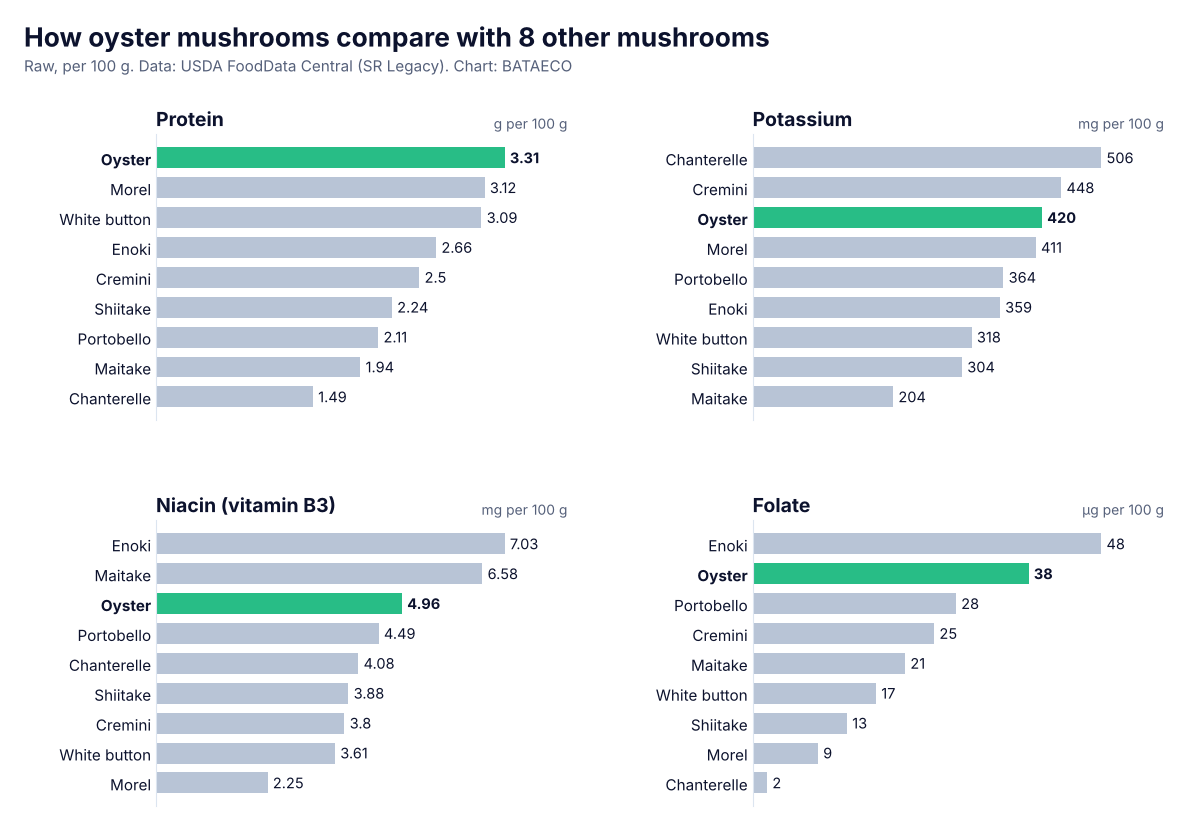
- Protein: oyster mushrooms ranked first of the nine, with 3.31 g per 100 g, ahead of morels (3.12 g) and white button mushrooms (3.09 g).
- Folate: second, with 38 µg, behind only enoki (48 µg).
- Potassium and niacin: third in both, with 420 mg of potassium and 4.96 mg of niacin (vitamin B3).
- Calories: just 33 kcal per 100 g.
- B vitamins: using the FDA Daily Values, I calculated that 100 g of raw oyster mushrooms provides about 31% of the daily value for niacin, 27% for riboflavin and 26% for pantothenic acid.
My take as a biologist: oyster mushrooms are a genuinely good food, but the numbers also show the limits of the hype. Ranking first for protein among mushrooms still means only about 7% of the daily value per 100 g, so mushrooms are not a protein source in the way beans or eggs are. And per calorie, white button mushrooms actually deliver more protein: about 14 g per 100 kcal versus 10 g for oyster mushrooms. Where oysters really stand out is B vitamins and folate. The likely biological reason fits their lifestyle: a fungus that hunts worms for nitrogen and digests whole logs needs a lot of enzymes, and many of those enzymes depend on B vitamins. One limit of this data: nutrient values vary with strain, substrate and growing conditions, and cooking changes them.
Oyster Mushroom Benefits
Beyond B vitamins and potassium, oyster mushrooms contain beta glucans, a type of fiber found in fungal cell walls, and ergothioneine, an antioxidant that humans cannot make and get mainly from mushrooms. Small studies have linked oyster mushroom extracts to lower cholesterol and blood sugar, but most research uses concentrated extracts or animal models, so it does not prove that eating oyster mushrooms prevents disease. The safest summary is that they are a nutritious, low calorie food.
What Do Oyster Mushrooms Taste Like?
Oyster mushrooms have a mild, slightly sweet and savory flavor with a soft, velvety texture. King oysters are firmer and are often sliced and seared like scallops. The stems of pearl and blue oysters are edible but can be tough at the base, so many cooks trim them. Always cook oyster mushrooms rather than eating them raw, which makes them easier to digest.
How to Grow Oyster Mushrooms
Oyster mushrooms are the classic beginner species because their mycelium grows fast and outcompetes molds. The simplest route:
- Start with a grow kit or spawn. A kit is a block of colonized substrate that only needs opening and misting. Spawn is mycelium grown on grain, which you mix into your own substrate.
- Prepare a substrate. Chopped straw, hardwood sawdust or used coffee grounds work well. Pasteurize straw in hot water (about 65 to 80 °C for an hour) to reduce competing microbes.
- Inoculate and incubate. Mix spawn into the cooled substrate, pack it into a bag with small holes, and keep it at room temperature in low light until it turns white with mycelium, usually 2 to 4 weeks.
- Fruit. Move the bag to fresh air and indirect light, cut slits and keep the humidity high by misting. Tiny pins appear and grow into full mushrooms within about a week.
- Harvest when the cap edges are still slightly curled down, before they flatten and drop spores. Most blocks give two or three flushes.
Oyster mushrooms can also break down oil and other pollutants, a use called mycoremediation that works alongside the plant based methods in our guide to phytoremediation techniques.
As an Amazon Associate, BATAECO earns from qualifying purchases.
The Golden Oyster Problem
The golden oyster is beautiful and easy to grow, which is exactly how it escaped. Spores from home kits and farms have let it establish in forests in several US states, including Wisconsin, Iowa, Ohio and New York. A 2025 study in Current Biology, led by Aishwarya Veerabahu at the University of Wisconsin Madison, found that dead trees colonized by golden oysters had about half the diversity of fungal species as trees without it. Wood decay fungi shape how forests recycle nutrients and which insects and other organisms can live in dead wood, so a competitor that crowds out native fungi matters. If you grow golden oysters, harvest them young, before they release spores, and grow them indoors.
Frequently Asked Questions
Can you eat the stem of an oyster mushroom?
Yes. The stems are edible, though the base of a cluster can be tough and chewy, so many cooks trim it off or cook stems longer.
Are oyster mushrooms healthy?
Yes. They are low in calories and a good source of niacin, riboflavin, pantothenic acid, folate and potassium, and they contain fiber and the antioxidant ergothioneine.
Where do oyster mushrooms grow in the wild?
On dead or dying hardwood trees, logs and stumps in forests across North America, Europe and Asia, most often in cool weather from autumn to spring.
Is it safe to forage oyster mushrooms?
Oyster mushrooms are among the easier species to learn, but they have lookalikes, including angel wings and poisonous Omphalotus species. Only eat wild ones identified in person by an experienced expert.
Why are oyster mushrooms called carnivorous?
Their mycelium paralyzes and digests nematodes using a toxin released from tiny structures called toxocysts, which gives the fungus extra nitrogen in nitrogen poor wood.
Sources
- USDA Agricultural Research Service, FoodData Central (SR Legacy records for raw mushrooms).
- Academia Sinica (2023), Carnivorous oyster mushrooms kill nematodes with a volatile ketone, on Lee et al. in Science Advances.
- EurekAlert (2025), Invasive golden oyster mushrooms reduce fungal diversity, on Veerabahu et al. in Current Biology.

Erzsebet (Eli) Frey is a biologist with a BSc in Biology and an MSc in Ecology from the University of Belgrade. She has field and lab experience across Asia, the Middle East, Europe and South America and uses Python and machine learning on biological data. Based in Serbia, she writes BATAECO and also runs Simply Ecologist and Eco&Stylish.