
An environmental impact assessment (EIA) is a formal process for predicting and evaluating the environmental effects of a proposed project before a decision is made to approve it. Roads, dams, mines, wind farms, ports, pipelines and large buildings usually need one. The goal is to find the impacts early, avoid or reduce them, and give decision makers and the public the information they need. This guide explains the EIA process step by step, common methods, what goes into an EIA report, how infrastructure projects are assessed, how to choose a consultant, and real data on how long environmental impact statements take.
Where EIA Comes From
The United States was the first country to make environmental assessment a legal requirement, through the National Environmental Policy Act (NEPA), signed into law on 1 January 1970. Under NEPA, federal actions that may significantly affect the environment need an Environmental Impact Statement (EIS). The European Union adopted its first EIA Directive in 1985, and EIA is now required in some form in most countries. Principle 17 of the 1992 Rio Declaration on Environment and Development called on all nations to use EIA for activities likely to have significant adverse impacts.
The EIA Process, Step by Step
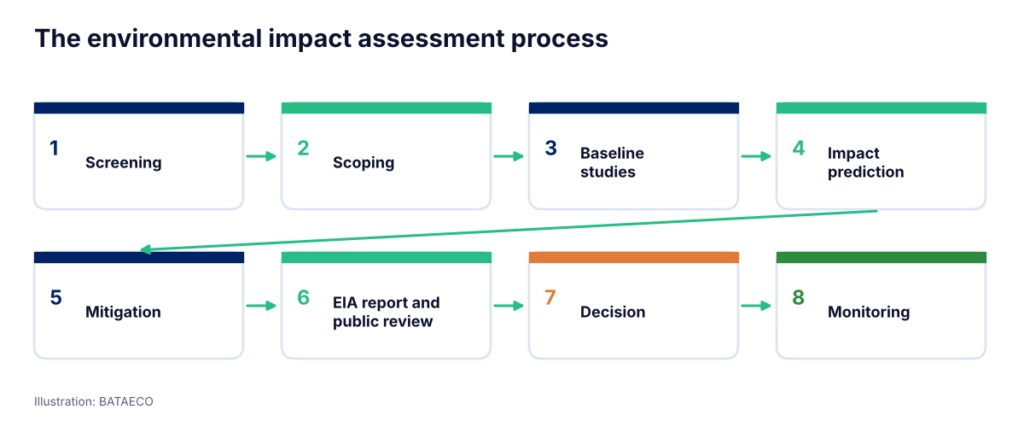
- Screening: deciding whether a project needs a full EIA, based on its type, size and location. Small projects or those in categories known to have minor effects may be exempt or need only a simpler assessment.
- Scoping: identifying the impacts that matter most, the alternatives to compare and the studies needed, often with input from authorities and the public. Good scoping keeps the assessment focused.
- Baseline studies: describing the environment as it is now: habitats and species, water quality, air, noise, soils, landscape, cultural heritage and local communities. For ecology this usually means field surveys over at least one full season.
- Impact prediction and evaluation: estimating what will change, how much, for how long and how significant each effect is, including cumulative impacts with other projects.
- Mitigation: planning measures to deal with each significant impact, following the mitigation hierarchy: first avoid, then minimize, then restore, and only as a last resort offset.
- EIA report and public review: documenting everything in an EIA report (called an environmental statement or EIS in some countries), publishing it and inviting comments.
- Decision: the authority approves the project, approves it with conditions, or refuses it, taking the assessment into account.
- Monitoring and follow up: checking during construction and operation that impacts are as predicted and mitigation works, and correcting course if not.
EIA Methods
Practitioners use a toolbox of methods, often combined:
- Checklists list typical impacts for a project type so nothing obvious is missed.
- Matrices, such as the classic Leopold matrix, cross project activities with environmental components and score the size and importance of each interaction.
- Networks trace chains of cause and effect, showing secondary impacts, for example how clearing a slope increases erosion, which raises sediment in a stream, which harms fish spawning.
- Overlay mapping and GIS combine maps of the project footprint with habitats, protected areas, water bodies and settlements to locate conflicts.
- Quantitative models predict air dispersion, noise levels, water quality, traffic or species population effects.
- Expert judgment and consultation fill gaps where data are limited, and local knowledge often reveals issues that maps miss.
Specialized software now supports much of this work, as reviewed in our guide to environmental impact assessment software.
What Goes Into an EIA Report
- A non technical summary for the public
- Project description and the alternatives considered, including the option of not building
- The legal and policy framework
- Baseline conditions for each topic (ecology, water, air, noise, soils, landscape, heritage, social and health)
- Predicted impacts and their significance, including cumulative effects
- Mitigation measures and remaining (residual) impacts
- A monitoring plan
- Methods, data gaps and uncertainties
The ecological chapters depend on solid field data. Survey methods for habitats, plants, birds, bats, amphibians and mammals are covered in our guide to zoology field techniques.
EIA for Infrastructure Projects
Linear infrastructure such as roads, railways, pipelines and power lines brings particular challenges. These projects cross many habitats and landowners, cut wildlife movement routes, and attract further development along their path. Key issues include habitat fragmentation and road kill, which are addressed with wildlife crossings and fencing; changes to drainage and flooding; noise and air pollution near settlements; and induced effects, when a new road opens a forest to logging or settlement. Large dams and ports add changes to river flow, sediment transport and coastal processes that can reach far beyond the construction site.
Choosing an EIA Consultant
Most EIAs are prepared by consultancies hired by the developer. If you are commissioning one, look for: accredited specialists for each topic (for ecology, qualified ecologists with protected species experience); a track record with similar projects and authorities; realistic survey timing, because many species can only be surveyed in certain seasons; transparency about uncertainty; and independence, since an assessment that hides problems often causes delays later. Note that BATAECO is an educational biology site and does not offer consultancy services.
Case Study: How Long Do Environmental Impact Statements Take?
A common complaint about EIA is that it is slow. To see the real numbers, I charted data from the US Council on Environmental Quality, which analyzed all 1,276 Environmental Impact Statements with a final statement published between 2010 and 2018, measuring the time from the notice of intent to the final record of decision.
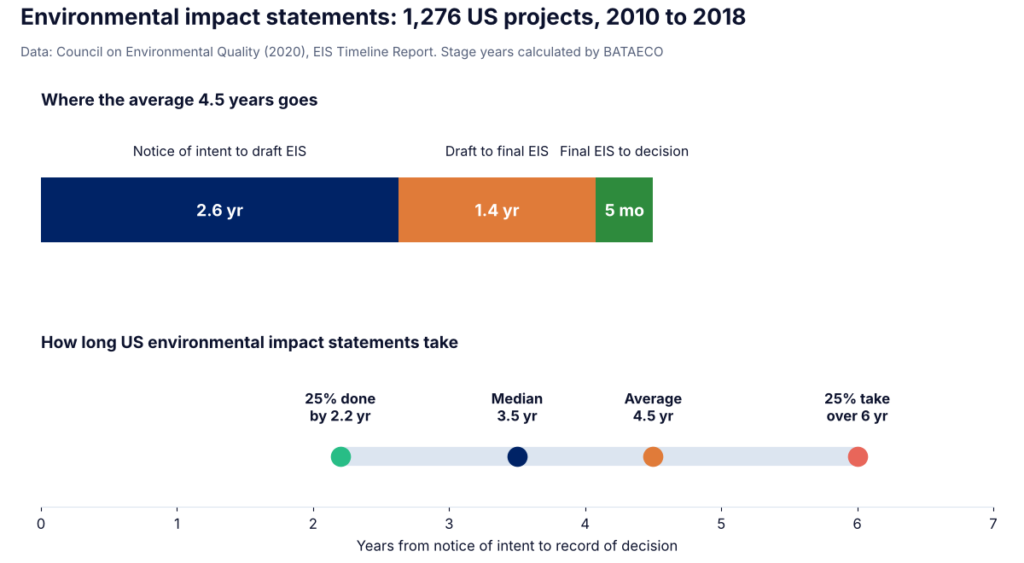
- The average EIS took 4.5 years from notice of intent to decision; the median was 3.5 years.
- The spread is wide. One quarter were finished in less than 2.2 years, while one quarter took more than 6 years. The average is higher than the median because a minority of very long, complex projects pull it up.
- Most of the time goes into the first stage. CEQ found that 58.4% of the time was spent between the notice of intent and the draft EIS, 32.2% between the draft and final EIS, and 9.4% between the final EIS and the decision. Applied to the 4.5 year average, I calculated that this is roughly 2.6 years to reach a draft, 1.4 years from draft to final, and about 5 months to a decision.
My take as a biologist: the longest stage is the one where baseline surveys and impact studies happen, and ecological fieldwork is genuinely seasonal: if a bat or amphibian survey window is missed, the project waits a year. Much of the delay that gets blamed on environmental review actually comes from late, incomplete scoping and surveys started too late. Early, well planned baseline work is the best way to make an EIA both faster and more reliable. One limit of this data: it covers only full federal EISs in the United States, which are the largest and most complex cases; most projects go through much shorter assessments.
Frequently Asked Questions
What is the purpose of an environmental impact assessment?
To identify a project’s likely environmental effects before approval, so they can be avoided or reduced and decision makers and the public are informed.
What are the main stages of EIA?
Screening, scoping, baseline studies, impact prediction, mitigation, reporting and public review, decision, and monitoring.
What is the difference between an EIA and an EIS?
EIA is the overall assessment process. An EIS (Environmental Impact Statement) is the detailed report required under the US National Environmental Policy Act; other countries call the report an EIA report or environmental statement.
What is the mitigation hierarchy?
The order for dealing with impacts: avoid them first, then minimize, then restore affected areas, and only as a last resort offset remaining impacts elsewhere.
How long does an environmental impact assessment take?
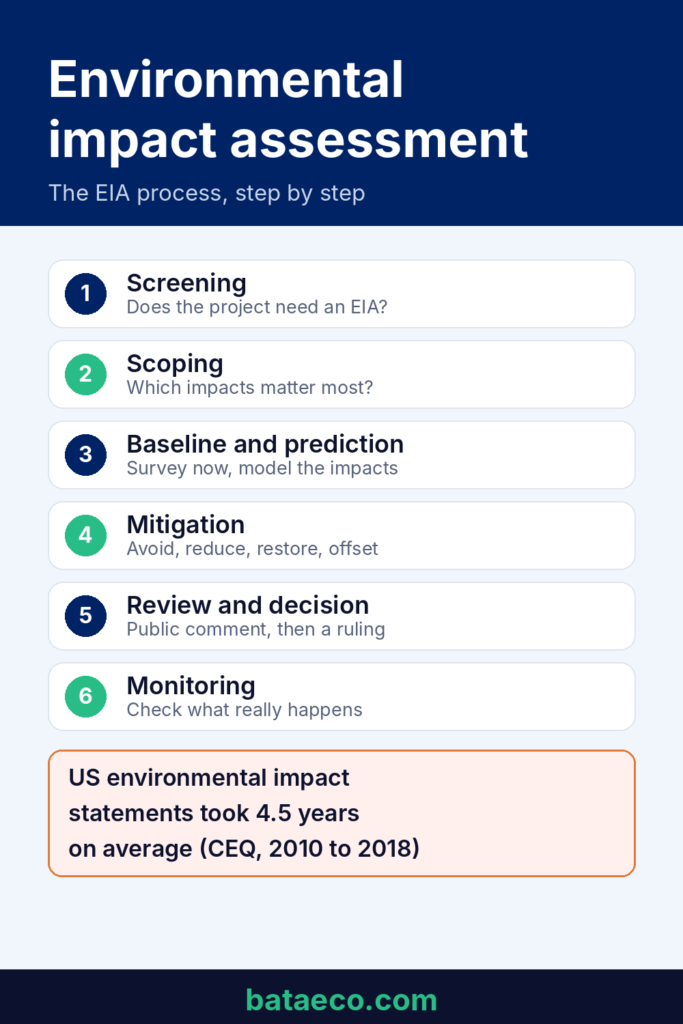
It varies with project size. Full US Environmental Impact Statements took 4.5 years on average from 2010 to 2018, while smaller assessments can take months.
Sources
- Council on Environmental Quality (2020), Environmental Impact Statement Timelines (2010 to 2018).
- European Commission, Environmental Impact Assessment.

Erzsebet (Eli) Frey is a biologist with a BSc in Biology and an MSc in Ecology from the University of Belgrade. She has field and lab experience across Asia, the Middle East, Europe and South America and uses Python and machine learning on biological data. Based in Serbia, she writes BATAECO and also runs Simply Ecologist and Eco&Stylish.