
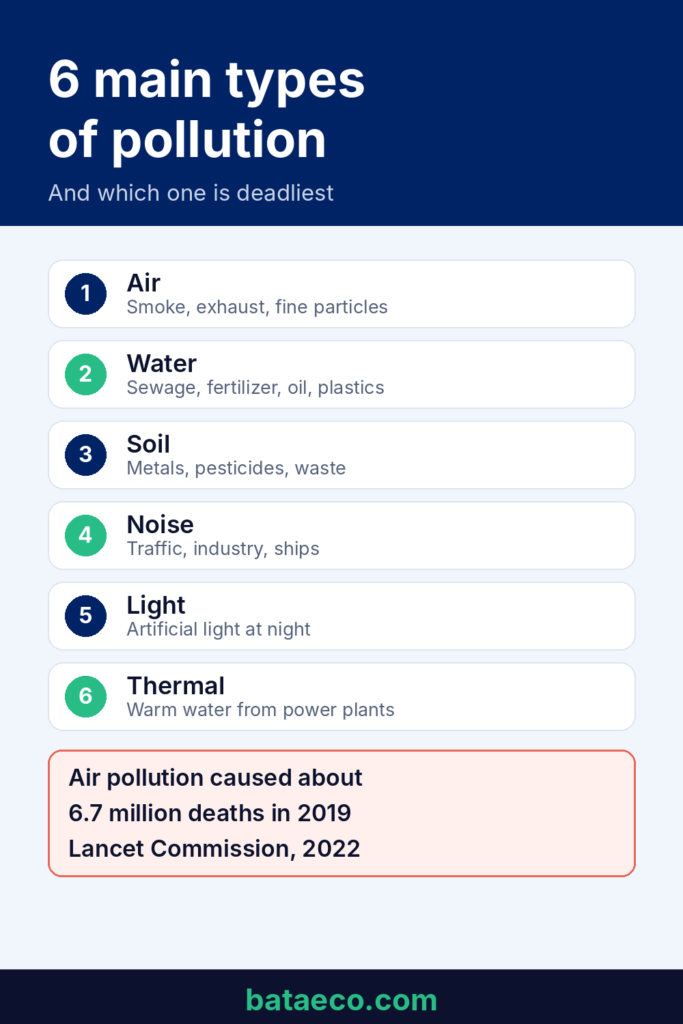
Pollution is any substance or form of energy released into the environment faster than it can be broken down, diluted or stored safely, causing harm to living things. The main types of pollution are air, water, soil, noise, light and thermal pollution. Some are chemicals, others are forms of energy such as sound, light or heat. This guide explains each type of pollution, what causes it, how it affects people and wildlife, and which type causes the most harm, based on the latest global data.
Air Pollution
Air pollution is the release of gases and particles that harm health and ecosystems. The most damaging are fine particles (PM2.5) small enough to reach deep into the lungs and bloodstream, along with nitrogen oxides, sulfur dioxide, ground level ozone and carbon monoxide.
- Causes: burning fossil fuels in vehicles, power plants and industry; burning wood, coal or dung in household stoves; wildfires; agriculture (ammonia from fertilizer and livestock).
- Effects on people: heart disease, stroke, lung cancer, asthma and other respiratory disease.
- Effects on nature: acid rain damages forests, lakes and soils; ozone reduces plant growth and crop yields; nitrogen deposition favors a few fast growing plants over many slow growing ones, lowering plant diversity.
Water Pollution
Water pollution is contamination of rivers, lakes, groundwater and seas by sewage, fertilizers, industrial chemicals, oil and plastics. It harms drinking water supplies and aquatic life, and it can create oxygen starved dead zones. It is covered in depth in our guide to water pollution causes and effects.
Soil Pollution
Soil pollution, or soil contamination, is the build up of harmful substances in soil. Common pollutants include heavy metals such as lead, cadmium and mercury; pesticides and herbicides; petroleum products; industrial solvents; and plastics, including microplastics from fragmented waste and plastic mulch.
- Causes: mining and smelting, industrial waste, leaking landfills and storage tanks, overuse of agricultural chemicals, sewage sludge and illegal dumping.
- Effects: contaminants are taken up by crops and enter the food chain; they kill soil organisms such as earthworms, fungi and bacteria that keep soil fertile; and they leach into groundwater and rivers.
Soil pollution is easy to overlook because it is invisible, and it can persist for decades. Some pollutants build up in organisms and become more concentrated at each step of the food chain, a process explained in our guide to ecotoxicology.
Noise Pollution
Noise pollution is unwanted or harmful sound from human activity: road traffic, aircraft, railways, construction, industry and, underwater, ship engines and sonar.
- Effects on people: sleep disturbance, stress, hearing loss and higher risk of heart disease with long term exposure.
- Effects on wildlife: many animals depend on sound to find mates, avoid predators and stay in contact. Traffic noise masks birdsong, and some urban birds sing louder or at a higher pitch to be heard. In the ocean, ship noise interferes with communication in whales and dolphins.
Light Pollution
Light pollution is excessive or misdirected artificial light at night: streetlights, illuminated buildings, advertising and sky glow over cities.
- Effects on wildlife: sea turtle hatchlings head toward bright inland lights instead of the sea; migrating birds are drawn to lit buildings and collide with them; huge numbers of insects die circling lamps; and the timing of plant flowering and animal breeding can shift.
- Effects on people: disrupted sleep and body clocks, and the loss of a dark night sky for most of the world’s urban population.
Light pollution is the easiest type to fix: shielded fixtures that point downward, warmer colored bulbs and switching lights off when not needed all reduce it immediately.
Thermal Pollution
Thermal pollution is a harmful change in water temperature caused by human activity, most often warm water released by power plants and factories that use rivers, lakes or the sea for cooling. Removing shade trees along streams and runoff from hot paved surfaces also warm water.
- Less oxygen: warm water holds less dissolved oxygen, while fish and invertebrates need more oxygen as their metabolism speeds up in heat.
- Thermal shock: sudden temperature changes, for example when a plant starts up or shuts down, can kill fish that cannot move away.
- Ecosystem changes: species adapted to cold water decline, while warm water species and algal blooms increase.
Other Types of Pollution
Some lists add more categories: plastic pollution (which overlaps with water and soil pollution), radioactive pollution from nuclear accidents and waste, and visual pollution such as billboards and overhead cables. They are less often treated as separate types, but plastic in particular is now found in almost every environment on Earth.
Case Study: Which Type of Pollution Causes the Most Deaths?
To compare pollution types on a single scale, I charted the latest estimates from the Lancet Commission on Pollution and Health, published as a progress update by Fuller and colleagues in 2022. It estimates that pollution caused about 9 million premature deaths in 2019, roughly the same as in 2015.
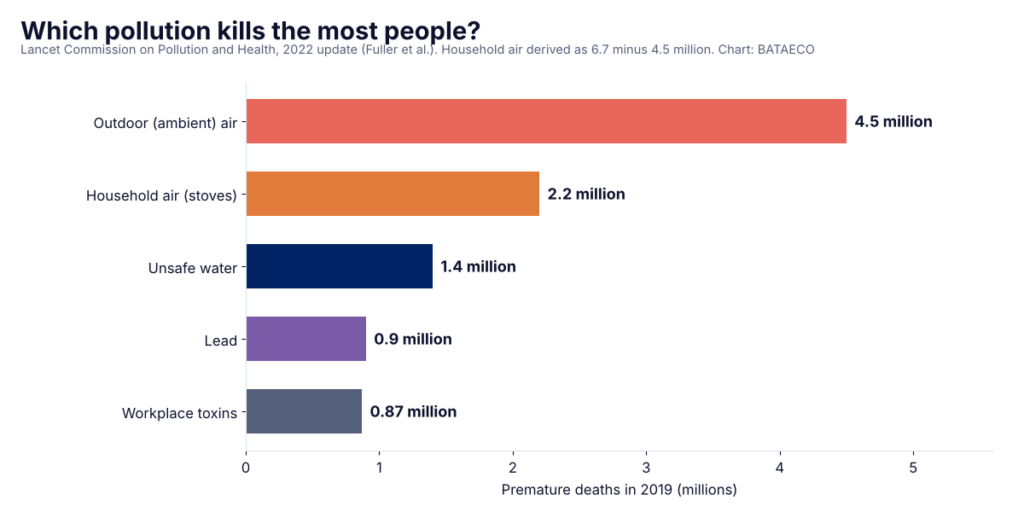
- Air pollution is by far the deadliest, with 6.7 million deaths, about three quarters of the total. Outdoor air pollution from vehicles, industry and power plants caused 4.5 million; I derived household air pollution, mostly from inefficient cooking stoves, as the remaining 2.2 million.
- Water pollution caused 1.4 million deaths, lead about 900,000 and workplace toxins about 870,000.
- The mix is shifting. Deaths from outdoor air pollution rose from 2.9 million in 2000 to 4.2 million in 2015 and 4.5 million in 2019, a rise of 55% since 2000. Deaths from household stoves and dirty water fell over the same period, which is why the total stayed roughly flat.
My take as a biologist: the numbers show two different pollution problems. The older one, dirty water and smoky kitchens, is a problem of poverty and is slowly shrinking as sanitation and clean cooking spread. The newer one, outdoor air pollution from industry and traffic, grows with development. Note what the chart cannot show: noise, light and thermal pollution rarely kill people directly, so they do not appear in death counts, yet they can be devastating for wildlife. A ranking based on human deaths is only one way to measure harm. The categories also overlap, so the bars should not be added together.
Frequently Asked Questions
What are the main types of pollution?
Air, water, soil, noise, light and thermal pollution. Plastic and radioactive pollution are often added as separate categories.
Which type of pollution is the most dangerous?
For human health, air pollution: it caused an estimated 6.7 million premature deaths in 2019, about three quarters of all pollution related deaths.
What is thermal pollution?
A harmful rise or sudden change in water temperature, usually from power plants and factories releasing warm cooling water, which lowers dissolved oxygen and stresses aquatic life.
How does pollution affect animals?
Chemical pollutants poison animals or build up in food chains, noise masks communication, artificial light disrupts navigation and breeding, and warm or oxygen poor water kills fish and invertebrates.
What are the causes of soil pollution?
Mining, industrial waste, leaking landfills and fuel tanks, overuse of pesticides and fertilizers, sewage sludge and plastic waste.
Sources
- Fuller, R. et al. (2022). Pollution and health: a progress update. The Lancet Planetary Health 6: e535 to e547. doi.org/10.1016/S2542-5196(22)00090-0
- Phys.org (2022), Global pollution kills 9 million people a year.

Erzsebet (Eli) Frey is a biologist with a BSc in Biology and an MSc in Ecology from the University of Belgrade. She has field and lab experience across Asia, the Middle East, Europe and South America and uses Python and machine learning on biological data. Based in Serbia, she writes BATAECO and also runs Simply Ecologist and Eco&Stylish.